
Specify a tear-away display carton by approving the complete opening sequence with the actual retail packs inside. Give staff an accessible starting point, keep the removal path clear of the contents, and confirm that the remaining tray still holds and presents the products after the upper section is removed. Do not select a perforation pattern from appearance alone or assume a successful empty-box tear proves the filled pack will work.
This purchasing decision concerns two states of the same package: closed for its agreed handling arrangement and open for retail display. A clean-looking render can conceal a difficult grip point, a torn branding panel or a tray weakened during conversion. The following framework helps chocolate brands, snack suppliers and retail packaging buyers define what to sample before releasing print and tooling.

Decide whether a tear-away structure is the right route
A tear-away display carton uses a deliberately removable section to expose the saleable packs while retaining the intended display base. Compare it with a separate cover or a folding pop-up header before committing. The useful question is what store staff should remove, retain and handle, rather than which mechanism looks most impressive in a photograph.
The custom cardboard counter display range with printed headers includes tear-away and pop-up concepts alongside other tray formats. Its current product brief explicitly requires project-specific confirmation of opening action and packed shipping suitability. Treat those alternatives as development starting points, not interchangeable approved specifications.
| Opening route | Reason to investigate it | Purchasing trade-off |
|---|---|---|
| Removable perforated section | A closed pack converts to a retained display tray | Qualify the tear path and the tray left behind |
| Separate cover | The buyer wants opening without tearing the display wall | Account for the extra component, fit and removal step |
| Folding pop-up header | The lid is retained as a branding panel | Check the folding sequence, locks and header support |
These routes need separate structural development. As an industry example, Smurfit Westrock’s retail-ready packaging portfolio includes both easy-opening concepts and a solution described as avoiding perforations. That shows why perforating a wall is a choice to evaluate, not an essential feature of every retail-ready pack. It does not establish NEXA’s access to another manufacturer’s proprietary design.
Define the opening task before drawing the tear line
Write a short store instruction in plain language: identify the start, remove the specified section and place the retained tray in its selling position. Ask which part staff hold while opening and where the detached material goes. If the sequence needs explanation by the designer each time, the opening brief is not yet ready for a retailer.
FEFCO’s shelf-ready packaging guidance calls for easy opening with clear graphic instructions, appropriate opening locations and accessible primary packs. That guidance concerns corrugated shelf-ready packaging. Its handling questions are useful here, but they do not validate a particular solid-paperboard display or create a universal opening-force requirement.
State the supplied configuration. Does the brand load the display in its warehouse, or does the retailer erect an empty tray and add products? Is the closed display inside another case? The answer determines which closed pack, contents and accessories must be present during the opening trial. Empty packaging production does not automatically include product filling or retail setup.
Use filled retail packs to define the protected space
For individual chocolate-bar retail cartons, supply finished examples with the intended bar and inner wrapper. Record the largest relevant outside dimensions, including wrapper seams and any projecting closure. Do not use an unwrapped bar or a flat artwork file as the only reference for the occupied space inside the display.
Ask the designer to show the retained tray, removable section and occupied product space on the same structural review. Check the complete removal movement, including corners and the last point of separation. A panel that clears the packs at its starting position can still catch a carton when it is pulled away.
Separate layout decisions from opening decisions. The approved number of facings does not approve the tear path. For the capacity calculation itself, use the existing guide to choosing display capacity from finished retail packs; this brief addresses what happens when staff convert the closed structure into that display.

Make the starting point usable without exposing the contents
Review whether fingers can reach and grasp the proposed tab or opening feature in the filled configuration. Check that nearby tape, a transport accessory or the product arrangement does not hide it. Agree where the other hand supports the pack so that staff do not have to squeeze the saleable cartons to begin.
For window chocolate cartons with removable printed belly bands, include the actual window and band in the trial. Inspect whether the moving display panel rubs a window surface, lifts the band or snags an exposed edge. Approval of a plain rectangular dummy does not cover those additional features.
If the intended method is tool-free, write that into the sample task and evaluate it accordingly. Do not repair an unclear opening sequence by assuming store staff will find a safe place for a knife. Conversely, do not advertise tool-free opening merely because a perforation is visible on a concept drawing.
Qualify the perforation with the chosen material and process
Ask the converter to propose the cut-and-uncut pattern, starting feature and route for the actual board and structure. Request identification of the proposed material and tooling revision. There is no generic cut-to-bridge ratio, tear force or corner allowance recommended in this article; those choices need project-specific development.
A 1993 experimental study of carton-board perforation quality, available through NC State’s BioResources archive, examined rule condition, cutting depth and board properties. Its results caution that unaided visual inspection of a perforated line does not guarantee clean tearing. This supports testing the opening action, not borrowing a numerical setting from an unrelated board or treating the study as a current production specification.
Review the final material combination, including any coating or film in the opening area. If the material, finish or tool changes after the sample, identify which opening checks need repeating. A successful plain-board prototype is a development result; it is not automatic approval of every later decorated version.
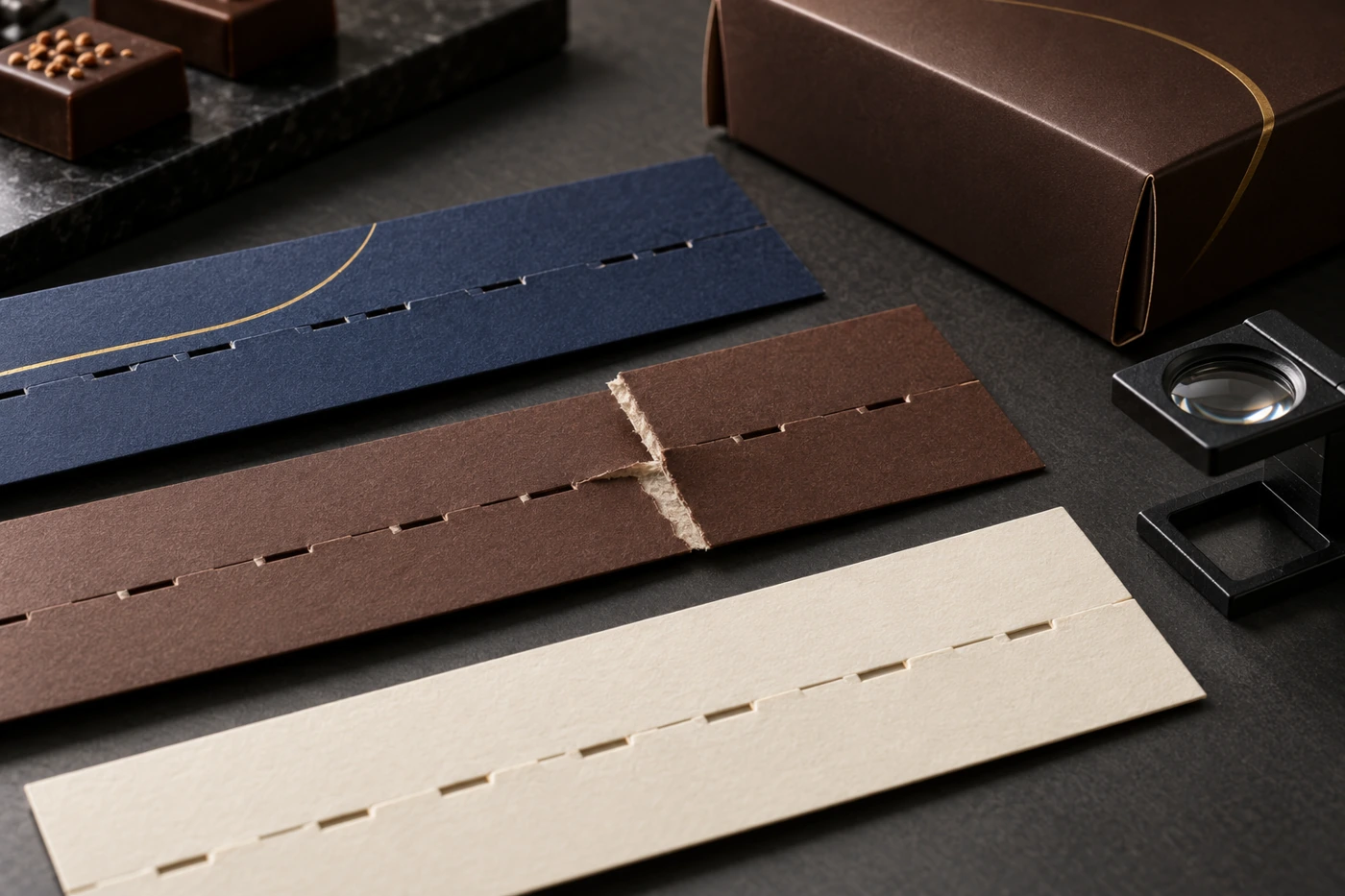
Judge the tray that remains, not just the section removed
After opening, inspect the front, side walls, corners and base of the retained tray. Look for tears leaving the intended route, loose fragments, lifted surface layers and damage that interferes with product presentation or handling. Agree observable acceptance descriptions and retain photographs or samples of acceptable and unacceptable outcomes.
With custom tuck-end chocolate cartons and sleeve-and-tray formats, trial the actual selected retail structure. A projecting tuck flap, a sliding component or a wrapper end can interact differently with the display’s last point of separation. Keep the retail pack identity attached to each result rather than recording only “chocolate box passed.”
Next, remove several products and inspect the display in ordinary use. The remaining wall should not need the full product load to disguise damage caused by opening. Check access to a single pack and whether staff can handle the retained tray as intended. These are proposed development observations, not a certified load or transport test.
Keep retained graphics clear of the removal boundary
Mark which printed panels survive conversion before placing the main message. Identify artwork that may disappear with the hood and information that must stay visible on the tray or individual packs. Check the opened sample from the shopper’s viewing direction; approving the closed face alone leaves the retail state unresolved.
For festive printed chocolate-bar gift cartons, review how the individual seasonal designs sit behind the display’s retained front wall. The display graphic should not depend on a removed upper section to identify the assortment. Keep the individual products’ approved physical information under their own content review.
Show the opening instruction on the component staff encounter before tearing. Avoid locating the only starting cue on an inner face that becomes visible after opening. Confirm any decorative treatment near the removal boundary with the converter and assess it on the finished sample rather than assuming a screen effect will remain tidy after tearing.

Approve closed handling and open presentation separately
The removable section needs to stay in the intended condition through the agreed packing and handling arrangement, then separate as intended at the store. Record both requirements. If the display ships filled, agree suitable distribution validation for the complete packed system with the appropriate supplier or test provider. A neat tabletop tear does not establish transit suitability.
During development, use unopened samples for each opening observation. Repeatedly pulling a previously opened component back into place cannot represent first opening. Ask the converter to propose how production-intent specimens will cover the relevant variants and changes; do not invent a universal sample count after an order fails.
Where an opening problem is found, distinguish a damaged incoming pack from an incorrect grip, an off-route tear or a weak retained tray. Keep the failed specimen and configuration record. Request a proposed correction and repeat the affected checks before treating the issue as resolved.
Include the conversion work in the quotation
Compare alternatives with the same retail pack, supplied state and delivery scope. Include structural development, tooling, production-intent samples, printing, finishes, assembly, any separate cover and the proposed transit packaging. A cheaper printed blank can transfer additional work or uncertainty to the warehouse or retailer.
Identify who approves the opening instructions and who owns the store trial. Confirm whether any filling, case packing or labeling service is included. These responsibilities matter as much as the die-cut feature when purchasing a display that must arrive, open and present consistently.
Sample-release checklist
- Name the closed configuration, retail packs and intended opening method.
- Identify the start, supporting grip, removal path and last separation point.
- Check clearance with windows, belly bands, flaps and wrapper seams present.
- Record the board, finish, tooling and artwork revisions represented.
- Inspect both the removed section and the retained tray after first opening.
- Check visible branding and individual-pack access in the opened state.
- Keep closed handling and any distribution approval separate from the tear trial.
- Record failures, agreed corrections, responsible approvers and recheck results.
Frequently asked questions
Is an easier tear always better?
No. Evaluate opening together with retention during the intended handling arrangement and the condition of the remaining tray. Optimizing only the tear can leave another part of the brief unresolved.
Can every display tray be converted by adding perforations?
Do not assume so. Ask for structural review of the removable and retained parts, product clearance and supplied configuration. A separate cover or retained folding header may be worth comparing.
Can we approve from an empty sample?
An empty prototype can answer early structural questions. The filled opening trial must include the actual saleable packs and relevant accessories before that configuration is accepted.
Does a clean opening prove shipping performance?
No. Confirm the intended transport arrangement and appropriate validation separately. The display is not automatically a replacement for a protective outer case.
Request a display matched to the opening task
Send NEXA Packaging filled retail-pack measurements and samples, the required display arrangement, opening sequence, supplied state, quantity per design, finishes and destination. Ask for a proposal that identifies what stays, what is removed and what evidence will support approval.
NEXA Packaging is an actual factory manufacturing custom paper boxes and custom paper tubes. Factory-direct pricing reduces trading intermediaries and their markups, while direct production communication supports cost control, scheduling and direct responsibility for manufacturing quality and follow-up. Regular production lead time is 7–15 working days, excluding shipping, with the order’s schedule confirmed according to quantity, structure, materials, finishes and final approvals. Sampling, filling services and distribution validation must be agreed in the relevant scope.
Editorial context: AI-assisted drafting and a separate model self-review using current product content and the linked primary references. Images are AI-generated structural-planning concepts, not engineering drawings, tested opening results, customer orders or real factory photographs. No human review or certified performance is claimed.