
Choose hot foil when a defined metallic accent needs a particular reflective character; consider metallic ink when the metallic effect belongs within a larger printed pattern or background. Neither route is automatically cheaper, brighter or more durable in every construction. For custom packaging, compare actual decorated samples on the proposed material, then price the complete finishing route at your order quantity. A gold shape in a PDF is not enough to specify either process.
The useful decision is not “which finish looks more expensive?” It is which route delivers the visual hierarchy your package needs without adding an unjustified operation or an unapproved appearance change. This guide compares the buying decisions behind hot foil vs metallic ink packaging, including what to request when one supplier offers foil and another proposes a printed alternative.

Define the metallic effect before naming the process
Start with the job the decoration must do. A small reflective emblem can act as the focal point on a quiet gift box. A continuous metallic pattern may support the background without dominating it. A silver information panel has a different job again: its text still needs to be read. Decide which elements require metallic reflection and which only need a gold or silver color.
For book-style rigid gift boxes with gold and silver foil options, identify the lid emblem, border and inside decoration separately. You may need a specific foil appearance on the emblem but not on every decorative line. That distinction lets the supplier quote purposeful alternatives instead of replacing all metallic elements with whichever process is easiest.
Send a physical reference where possible and describe what you like about it: hue, reflectivity, texture or contrast against the background. Avoid treating an online photograph as a measurable finish standard. The lighting and viewing angle may hide precisely the characteristic you are trying to buy.
Understand what the two routes actually specify
Conventional hot foil stamping uses a heated tool and pressure to transfer a decorative layer onto a substrate. KURZ’s hot-stamping overview describes metallic, glossy, pigmented and tactile effects, as well as dies for decorating cartons and box wraps. Consequently, “foil” does not mean one universal mirror-gold appearance. Specify the proposed finish reference, not just the word.
Metallic ink is an ink-based route using effect pigments rather than a stamped decorative transfer. ECKART’s printing-industry information identifies effect pigments and metallic inks for packaging across several printing processes. The available ink system and print route therefore matter. “Metallic printing” alone does not identify the ink, process, substrate or finished appearance.
Keep the comparison between named production proposals. Cold transfer and digital embellishment are other routes, not interchangeable names for conventional hot foil or metallic ink. If a supplier proposes one, request a separate specification and sample. This article does not establish that PaperBoxPro offers every ink system or alternative embellishment process; availability must be confirmed for the ordered package.
Match the choice to the design priority
| Design priority | Useful starting comparison | Evidence before approval |
|---|---|---|
| A small, strongly reflective focal mark | Include a specified metallic hot-foil option | Actual-stock sample viewed from several angles |
| A broad metallic pattern integrated with print | Ask whether an available metallic ink route meets the intended effect | Representative coverage and the complete coating sequence |
| Fine lines beside a large solid | Compare the achievable artwork in each proposed route | Finished-size trial containing both elements |
| A coordinated carton, rigid box and tube range | Specify appearance targets by format, not just one color name | Finished samples reviewed together |
This is a shortlist for testing, not a ranking of process capability. Some metallic inks produce very bright effects; some foils are deliberately matte. Choose the appearance you can approve physically rather than assuming every foil will outperform every ink.
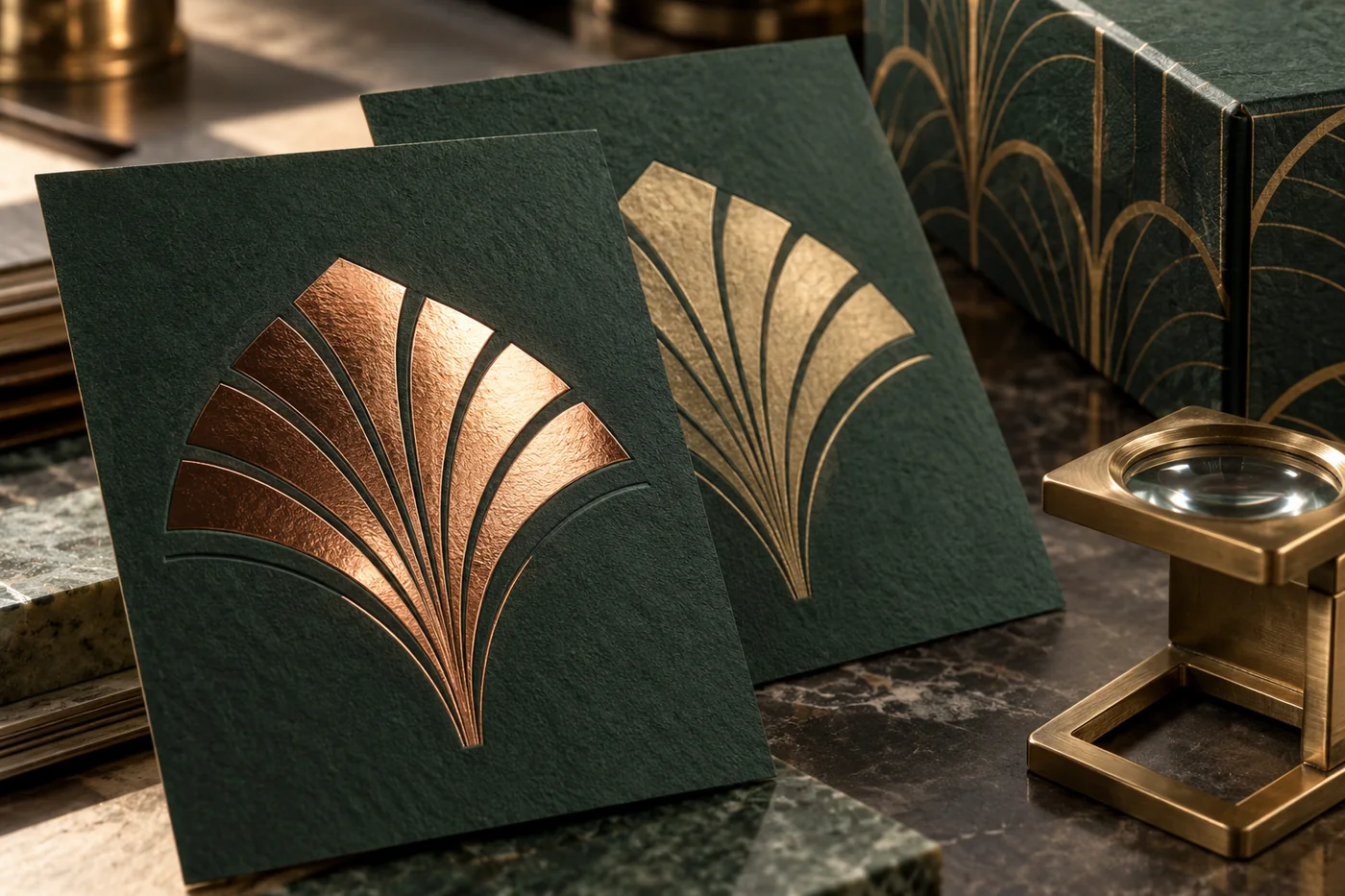
Keep the paper and protective finish in the comparison
A finish selected on one paper should not silently become the reference for another. Ask which board or wrap, printed background, coating and laminate each trial contains. If one sample uses smooth coated stock and the other uses textured paper, the comparison changes more than the metallic process. That can still be a useful design comparison, but it is not evidence of process superiority.
For white-card retail boxes with foil and lamination options, confirm the exact structure and surface treatment being quoted. That product page lists several formats; its options do not prove that every combination is suitable for every format. Ask for the specific assembly and finish sequence in the proposal.
Include any protective coating in the appearance approval. Ask whether it sits above or below the metallic decoration and inspect the final result, not an attractive unfinished sheet. Do not assume a coating is unnecessary, compatible or visually neutral. The converter should identify the proposed sequence and any testing still required.
Protect readability and functional zones
Separate decoration from essential information. For custom flip-top paperboard packs with metallic finishing options, keep the finish discussion tied to the agreed panel layout and opening sequence. Necessary information and any market-specific labeling require their own review; a decorative finish is not regulatory approval. Avoid placing decorative comparisons in information zones that are already constrained.
Ask the supplier to flag artwork near folds, glue areas and moving parts. Review the assembled package so a convincing flat proof does not conceal a disrupted border or an awkward reflection across a closure. Set the design priorities before requesting an expensive all-over metallic treatment.
Compare foil stamping costs with the complete ink alternative
Request both quotations at the same dimensions, structural materials, quantity per design, packing basis and delivery terms. Separate setup or tooling charges from recurring unit costs, and identify whether sampling and additional operations are included. Do not assume an ink alternative has no setup cost or that foil necessarily requires the same number of passes on every job.
A useful comparison is: one-time charges plus quantity multiplied by the quoted finished-unit cost, plus separately charged sampling and delivery. Apply the same boundary to both offers. If an alternative needs an extra coating, changed stock or another operation, include it before calling it a saving.
For example, a buyer considering a 1,000-box launch could request Proposal A with a small foil emblem and Proposal B with a metallic printed pattern. Those are different designs, not identical outcomes at different prices. Record whether the buyer accepts that design change. Then request a repeat-order quote showing which setup charges recur and which depend on artwork changes. These are hypothetical purchasing conditions, not supplier prices or promised savings.
Control the number of versions
For festive chocolate bar cartons with decorative finish choices, consider which motif stays common across flavors and which graphics change. A shared metallic element may be commercially useful, but ask whether the proposed layout actually permits shared tooling or setup. Different panel positions or artwork sizes may prevent reuse. These are outer-packaging choices, not evidence of suitability for direct food contact.

Use a sample comparison that can answer the buying question
Request metallic packaging samples using a small comparison brief containing a representative solid, fine positive lines, reversed gaps and the actual focal mark at finished size. Include only elements relevant to the proposed artwork. Ask each supplier to identify what the trial proves and what it does not: an appearance swatch, a press trial and a fully converted sample provide different evidence.
For a range of custom luxury paper boxes and removable-cap tubes, review each finished format together. A flat lid and a curved wall present decoration differently during use. Agree whether the priority is a shared decorative theme, a close visual match or a deliberately different accent on each format.
- Review the samples under the same lighting, with the background and orientation kept consistent.
- Tilt each sample to inspect its reflection, then return to a normal shelf-viewing position.
- Check hue, focal-point contrast, fine detail and information readability separately.
- Open, close and handle assembled samples using a mutually agreed procedure relevant to the package.
- Record the accepted sample, substrate, finish reference, process and artwork revision.
If the supplier cannot produce a representative trial, keep the decision provisional. A standard swatch can narrow the choice, but it should not become proof of adhesion, handling performance or appearance on an untested construction. Ask which approval step closes each remaining uncertainty.

A finishing RFQ checklist you can actually send
- Identify the package style, dimensions and quantity for every design or format.
- Mark the metallic elements and distinguish essential focal marks from optional decoration.
- Describe the intended appearance and provide a physical reference if available.
- Request the named foil or ink system and the proposed printing or stamping route.
- Specify the complete paper, background and coating or laminate stack.
- Ask for artwork limitations and a finished-size trial of the critical elements.
- Itemize setup, tooling, unit cost, sampling and any version-specific charges.
- Agree what the sample approves and how substitutions will be reviewed.
Keep the rejected alternative with the comparison record when useful. Knowing why a route was rejected—insufficient contrast, a changed design, an unavailable process or an unfavorable total quote—prevents a future reorder from reopening the same discussion without context.
Frequently asked questions
Can ordinary CMYK gold replace a metallic finish?
A gold-colored printed illustration can be a valid design choice, but do not specify it as equivalent to a reflective metallic effect. Approve it as a separate visual outcome rather than allowing the supplier to interpret a gold PDF shape without instructions.
Is foil stamping always more expensive than metallic ink printing?
No universal price rule is useful. Compare quotations for the complete package, including setup, coverage, versions and finishing sequence. A different process can also change the design, which must be accepted separately from the price.
Can a screen proof approve metallic appearance?
Use it to discuss placement and visual hierarchy. Request physical production-intent evidence for the actual metallic appearance and assembled result. The generated images in this guide illustrate design directions, not measured finish comparisons.
Should the whole range use one metallic process?
Only if the agreed samples and commercial requirements support that choice. Different formats can use different routes, provided their relationship is intentional and approved. Do not promise an exact match from a shared “gold” or “silver” description.
Ask for a buildable metallic finish proposal
Send PaperBoxPro your packaging artwork and metallic finish brief, including the box style, quantities, reference effect and intended use. Ask which options can be quoted and physically sampled for that construction. The strongest proposal explains the route, the complete cost boundary and the evidence needed before bulk production—not simply that the packaging will look luxurious.
Editorial context: AI-assisted drafting and model self-review using the linked manufacturer sources and product pages. Images are AI-generated packaging concepts, not actual customer projects, calibrated finish comparisons or engineering proofs. No human review or certification is claimed.