
Yes, your 0.5 ml and 1 ml cartridges can share one box and insert if the actual finished hardware fits the same support points, loading path and removal space across every approved model. Capacity alone is not enough to approve shared cartridge packaging. When the outer dimensions can be standardized but the contact geometry cannot, a common outer box with separate inserts is often the more useful option. Keep completely separate packs when neither arrangement passes the agreed checks.
For hardware suppliers, brand purchasing teams and contract packers, this is a component-management decision. A universal pack can reduce the number of components to replenish, but an unsuitable universal cavity moves the cost into packing work, rework or presentation problems. The objective is the smallest packaging family that works reliably, rather than the fewest part numbers on a spreadsheet.
Define exactly what you want to share
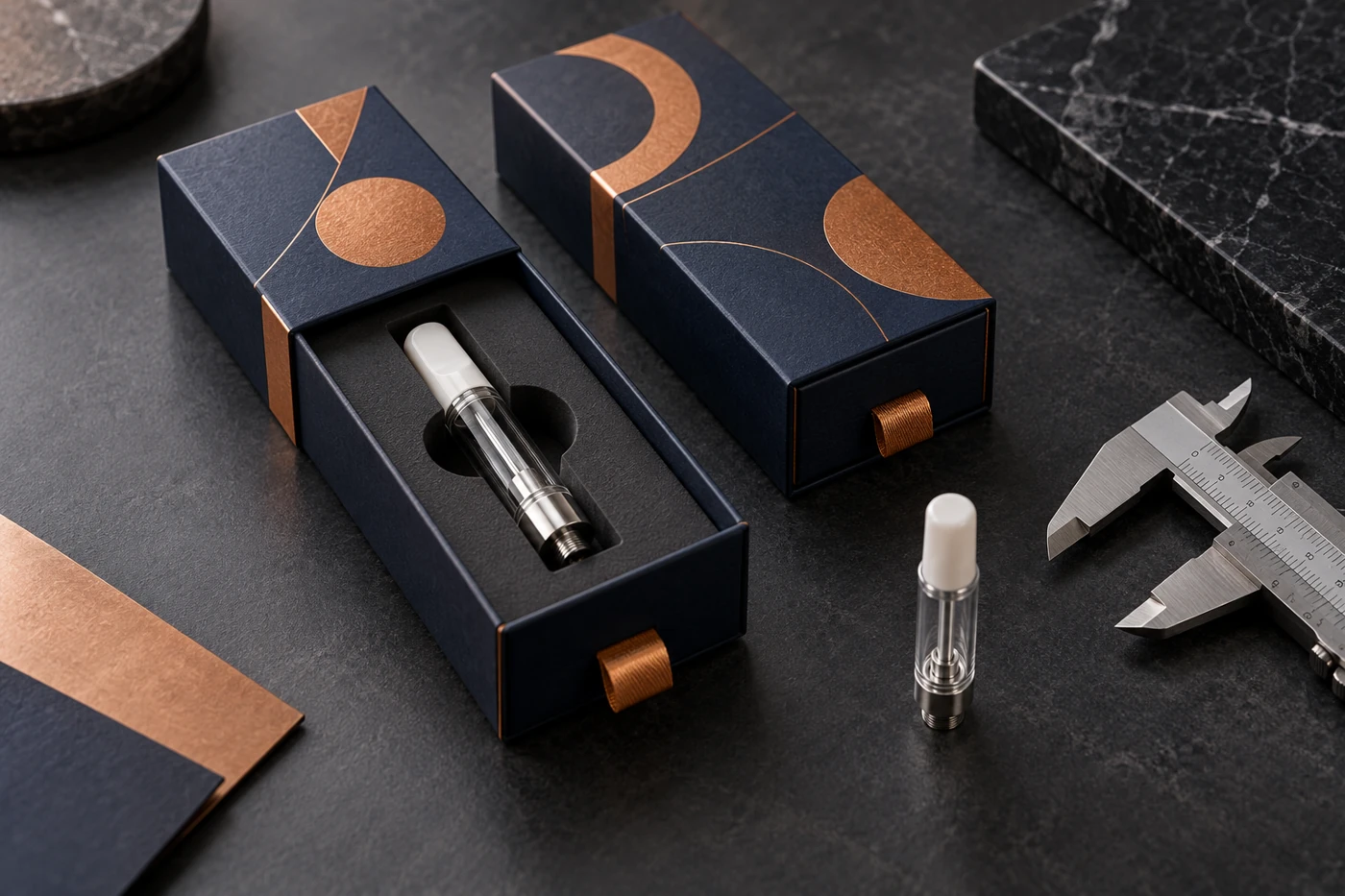
Separate four decisions: the outside box size, the printed artwork, the insert outline and the insert cavity. Two products may share an outside footprint while needing different inner supports. They may share the complete structure while needing different printed identification. Neither situation requires an all-or-nothing answer.
Start by reviewing the available custom cartridge box structures and insert options. The page covers several formats and both capacities, but that range is not evidence that every listed cartridge shares one cavity. Ask for a proposal tied to your actual hardware revisions. A statement such as “fits 0.5–1 ml” should become a list of approved models before purchasing releases an order.
Keep product identity separate from physical compatibility. Sharing an outer box does not authorize shared capacity statements, instructions or other market-specific information. If graphics must differ, identify the common structural components separately from the printed components in the quotation.
Compare three packaging routes
| Route | Good starting condition | Main purchasing tradeoff |
|---|---|---|
| One box and one insert | Every model uses compatible support zones and passes the same checks | Fewer components, but the acceptable hardware range must be controlled |
| One box, different inserts | Outer envelope is compatible; mouthpieces or contact positions differ | Common box replenishment with extra insert identification and stock control |
| Separate complete packs | Length, presentation or functional requirements differ too much | More stock lines, with less compromise in fit and access |
Treat these as proposals to sample, not automatic cost rankings. A common outer shell can still be expensive if it is oversized for most of the range. Conversely, two inexpensive insert variants may be easier to manage than one complex adjustable insert that requires extra folding at the packing station.
Build a hardware-family matrix before requesting a universal insert
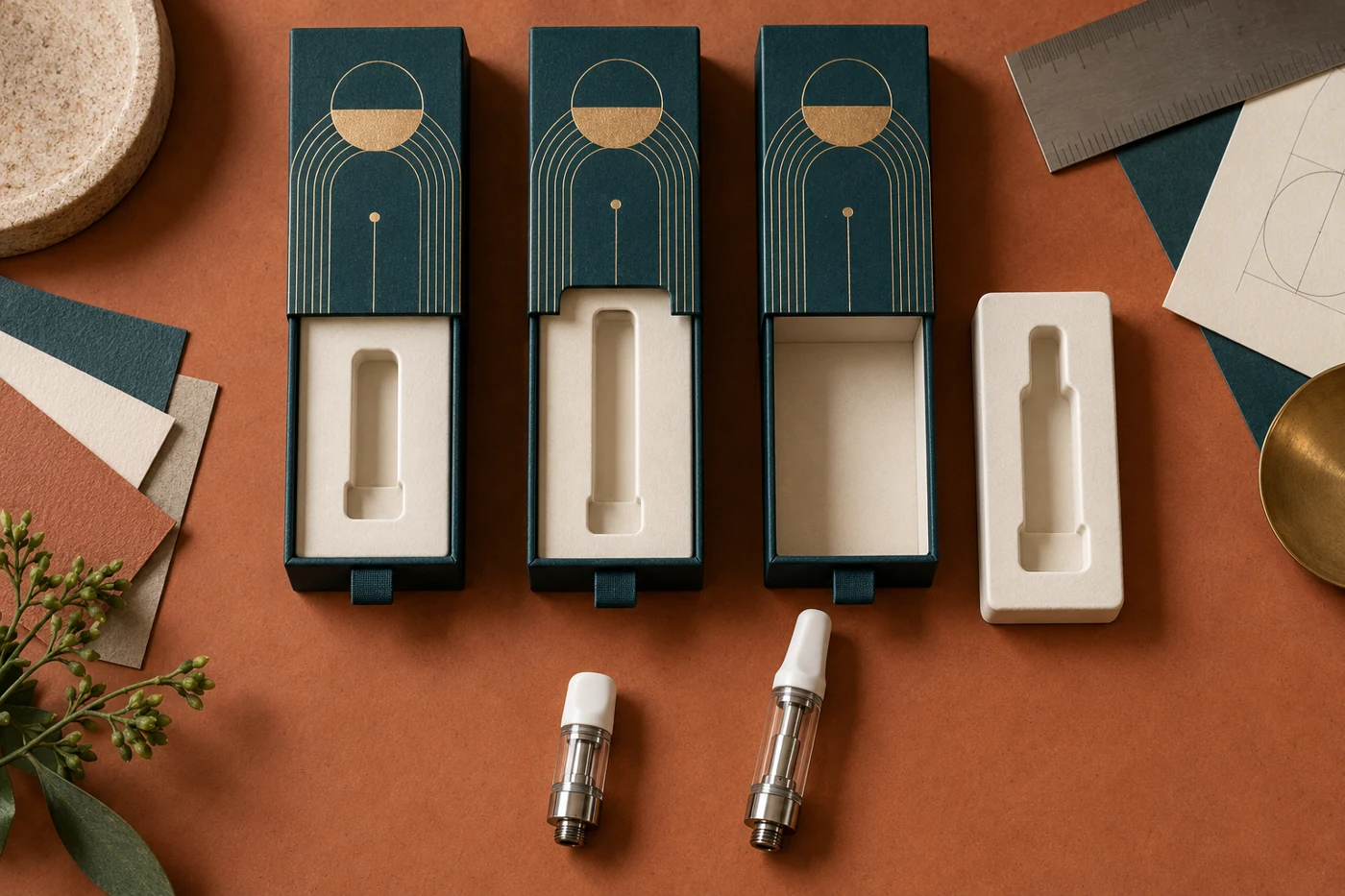
Give each model a stable identifier, including its hardware supplier and revision. Record the finished condition used for packing: mouthpiece assembled, protective caps fitted, labels applied and any other supplied components present. Distinguish nominal capacity from the dimensions that touch the package.
For every model, capture overall length, maximum body diameter, mouthpiece width and thickness, base projections, mass and the locations that may accept support. Record dimensional ranges from representative units rather than copying one nominal value. Where information is unavailable, mark it as unconfirmed and obtain samples; do not replace it with a guessed “standard 510” size.
A practical matrix needs a row for each model and columns for each proposed insert revision. Mark each combination as not checked, failed or approved, with the sample reference and date. This exposes a common purchasing error: approving the longest model and assuming that every shorter version will also work. A shorter item can lose end support or become difficult to grip even when the sleeve closes normally.
The windowed drawer format listed for 0.5–1 ml cartridges illustrates another dependency: a shared cavity must also place each model correctly behind the window. Physical containment and an acceptable retail reveal are separate approval questions. The listed capacity range is a starting point for sampling, not a universal compatibility guarantee.
Check support geometry, not just the biggest outline
Find contact zones that every model can tolerate
Ask the packaging designer to mark the proposed support zones on each hardware drawing. If the long model is held at its body while the short model rests against its mouthpiece, the insert is not performing the same job for both. That difference needs review before a common cavity is accepted.
A longer opening may accommodate several outlines but provide little restraint for the smallest one. A flexible tab may cover a useful range, yet it still needs sufficient travel, repeatable folding and acceptable contact pressure. Avoid specifying an arbitrary clearance or demanding that the factory simply “make it tighter.” Require the proposed geometry and the sample evidence instead.
Keep the loading and removal paths clear
Check the sequence from above and from the side. Can operators place both models without catching a cap beneath a bridge? Does the wider mouthpiece prevent the product from passing through the opening? Can the customer grip the shortest model without lifting out the complete insert?
For slide-out boxes with paperboard, foam or blister insert options, compare the same hardware family in the proposed construction. Material choice alone will not resolve an incompatible contact position. Keep the common-part decision separate from a general debate about which insert material looks most premium.

Use a common outer box when the cavity must differ
If both models fit within the same usable envelope but cannot share reliable support points, request two insert variants with an identical outside outline. Confirm that each insert locates in the tray the same way and leaves the same clearance for the drawer or lid. A nominally identical outline does not prove equal assembled height.
The drawer paper box described for a single 1 ml cartridge is a useful baseline for this discussion. Ask whether its outer format can remain common while the shorter model receives a different cavity or support platform. Do not adopt the page’s example dimensions as your specification without checking your own finished hardware.
Give the insert variants distinct part numbers and a practical identification method. Agree where that identification appears and verify that it remains available during packing. An unlabeled stack of visually similar white inserts can undermine the benefit of a common box. If orientation matters, include that in the packing instruction and sample review.
Compare total usable-pack cost
Request all three routes at the same forecast quantities by model. Separate shared outer-box quantities from model-specific insert quantities, artwork versions, tooling, setup and sample costs. Ask whether inserts arrive flat, erected, installed or separately packed. Otherwise, one quotation may include work that another leaves to your packing team.
Use a consistent calculation: total packaging-related purchase, setup, inbound handling and packing costs divided by the number of usable completed packs. Include known rework and obsolete-component costs where your own records support them. Leave unknown costs visible as assumptions rather than inventing savings percentages.
Run a sensitivity check for a changed sales mix. If the short model sells faster than expected, can you buy more of its insert without reordering the slower model’s printed boxes? If a future mouthpiece changes, which components become unusable? Shared packaging has value when it preserves useful flexibility; it is less attractive when one hardware revision strands the whole range.
Approve each configuration with the finished box
For every proposed shared combination, load representative hardware into production-intent packaging. Check the tightest and loosest expected combinations, tray seating, closure, presentation, removal and visible marking. Record results by hardware model and insert revision. Do not write one blanket approval against the outer-box artwork.
The custom 510 cartridge packaging format offered for both capacities provides another example to assess as a complete configuration. If a closure performance claim is required, handle that as a separate evidence requirement for the applicable package. An insert fit review does not establish child resistance, tamper evidence or regulatory compliance.
Agree distribution validation for the actual packed product and shipping route. ISTA’s official test-procedure overview distinguishes screening, partial-simulation and general-simulation approaches. Select the appropriate scope with the responsible packaging specialist or laboratory; a desk-side fit check does not establish transit performance. Record which configuration was evaluated and what changes require a new review.
Attach this release checklist to the purchase order
- List the exact hardware models and revisions approved for each insert.
- Identify common and variant-specific box, artwork and insert part numbers.
- Attach dimensioned drawings, material specifications and sample references.
- Define allowed support areas, loading direction and customer grip access.
- Record acceptance criteria and observed results for every model-and-insert combination.
- Specify insert identification, packing instructions and responsibility for assembly.
- State the shipping configuration and any required validation evidence.
- Require review before changing hardware, insert geometry or relevant package components.
Frequently asked questions
Does the same 510 connection mean the same insert will fit?
Do not use the connection designation as a packaging approval. Obtain the complete finished outline, contact-zone dimensions and samples for each model. Mouthpiece geometry and overall length still belong in the compatibility matrix.
Should we use the longest cartridge to set the box size?
It can help define the initial envelope, but it cannot approve the shorter models. Check their support, visual position and removal access separately. Also compare the storage and presentation cost of unused space.
Can one adjustable paper insert replace two separate inserts?
Possibly. Ask for the adjustment method and trial it with normal packing operators. Include folding time, incorrect settings and retention after assembly in the comparison. Do not assume adjustable means simpler or cheaper.
Must every hardware change trigger new packaging?
Not necessarily. Review the changed dimensions and contact areas against the approved compatibility range, then decide what sampling or testing is needed. Preserve the written decision so a purchasing substitution does not silently become a new configuration.
Request a shared-pack proposal with clear limits
Send NEXA Packaging your hardware-family matrix, representative samples, forecast quantities by model and preferred opening style. Ask for a common box and insert, a common box with variant inserts, and separate packs where appropriate, with assumptions and sample stages itemized.
NEXA Packaging is an actual factory manufacturing custom paper boxes and custom paper tubes. Factory-direct pricing reduces intermediary markups, and direct production communication supports cost control, scheduling and clear quality responsibility. The factory directly follows up production quality and related issues. Regular production lead time is 7–15 working days, excluding shipping; the confirmed schedule depends on quantity, materials, structure, finishes and final order approval. Compare like-for-like quotations rather than assuming any route is always cheaper or faster.
Editorial context: AI-assisted drafting with a separate model self-review using the linked primary guidance and current product content. Images are AI-generated packaging concepts showing empty hardware, not approved engineering designs, customer orders, factory photographs or test evidence. No human or laboratory review is claimed.