
Empty custom boxes take up excessive freight and storage space when their supplied form, master-carton packing and order quantity are decided after the retail design. Reduce that space by comparing the actual packed shipment: how the boxes arrive, how many usable units fit in each outer case, and what your carrier charges for that case. A lighter retail box is not necessarily a smaller or cheaper shipment.
This guide is for buyers importing empty printed cartons, rigid gift boxes and paper tubes. It provides a way to compare supply and packing options before ordering. The examples are hypothetical calculations, not PaperBoxPro quotations, measured product capacities or promised savings.

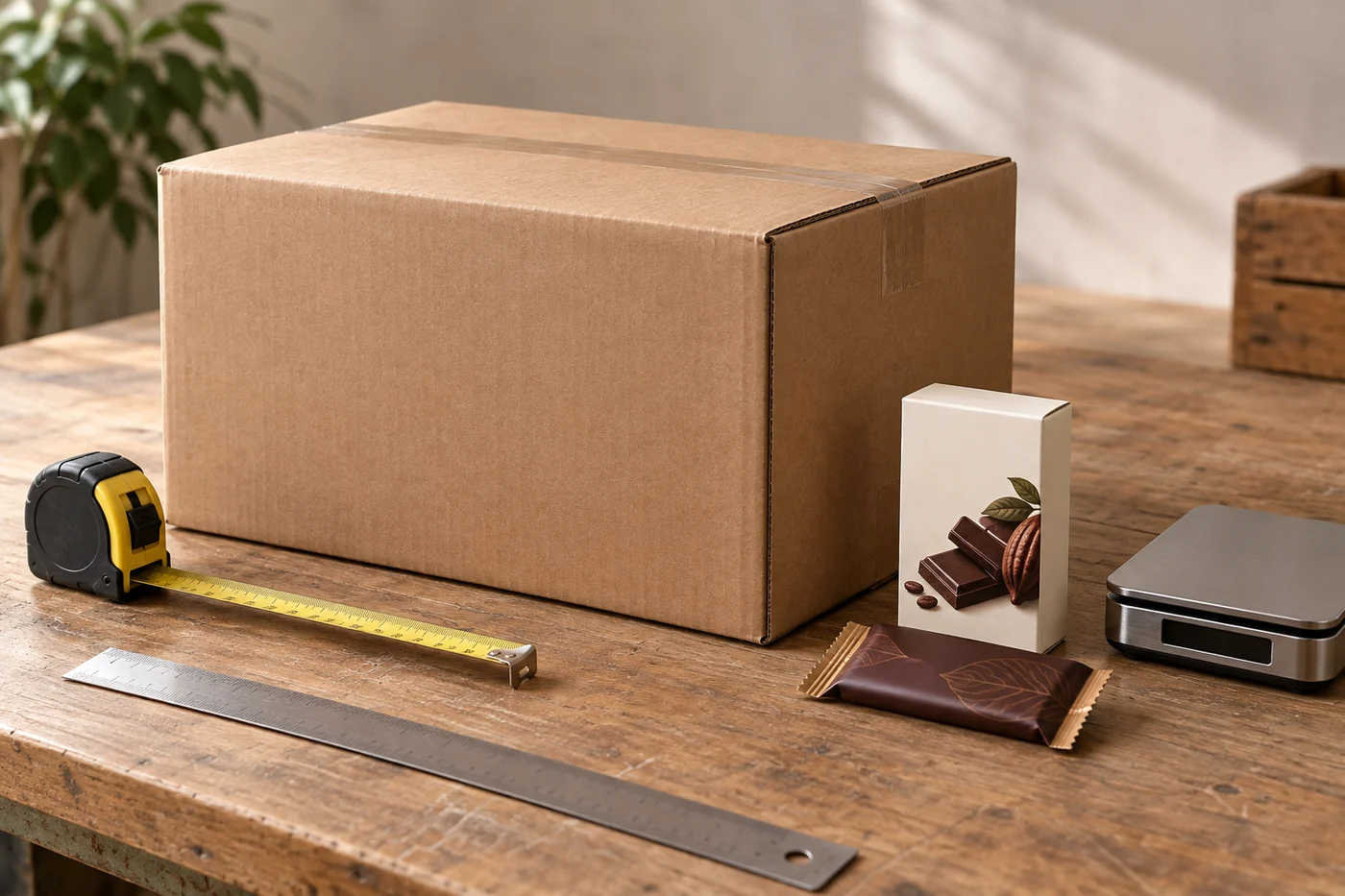
Measure the shipment, not just the finished retail box
The internal dimensions of a retail box answer a product-fit question. Its assembled external dimensions describe the presentation. Neither tells you the dimensions of the shipping case containing a batch of empty boxes. Request all three measurements and label them clearly.
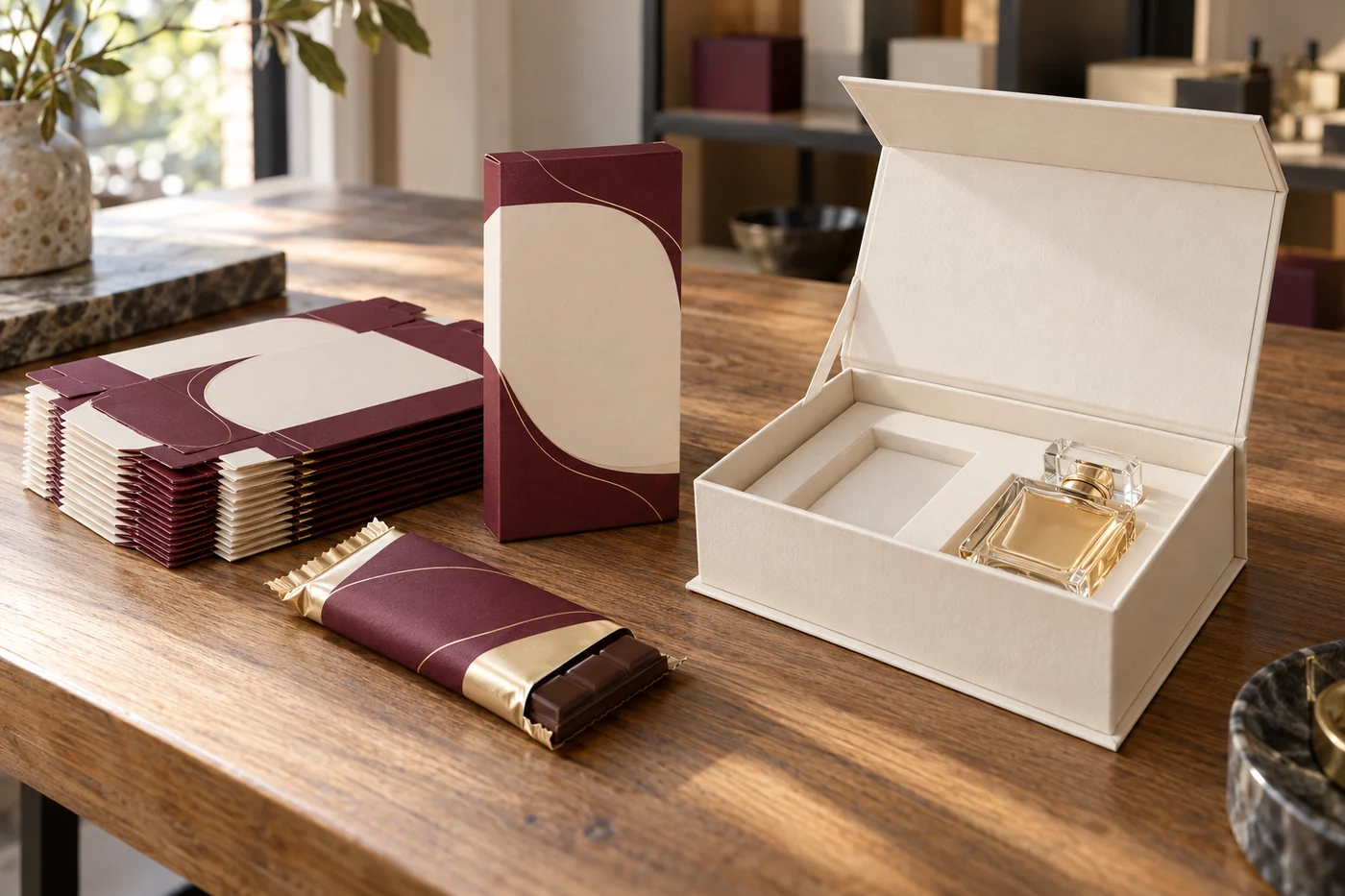
A folding carton might arrive as a flat pre-glued bundle, an unglued blank or a formed box. A conventional rigid box usually retains its three-dimensional shape. An insert may arrive fitted inside it or packed separately. Those choices change the shipping footprint even if the customer sees the same finished design.
When specifying custom chocolate bar packaging, ask the supplier to identify the proposed construction and supplied state. Do not assume that a product photograph showing an erected pack means it will be shipped that way, or that every structure described as a carton can be flattened after assembly.
Find out whether the shipment is limited by weight or space
For a parcel service using dimensional weight, the chargeable weight can exceed the weight shown on a scale. DHL Express UK’s measuring guidance describes comparing actual and volumetric weight and publishes a centimetre-based volumetric calculation using a divisor of 5,000. Confirm the applicable service, measurement and rounding rules when obtaining your quotation.
For an illustration only, a case measuring 60 × 40 × 40 cm has a volume of 96,000 cm³. Dividing by 5,000 gives 19.2 kg of dimensional weight. If the actual gross weight is 12 kg, the dimensional figure is higher. That result is a calculation before service-specific rounding and charges, not a shipping price.
A hypothetical alternative case measuring 50 × 35 × 25 cm has a volume of 43,750 cm³ and a dimensional result of 8.75 kg under the same divisor. If its gross weight is still 12 kg, actual weight becomes the higher figure. Reducing volume further would not reduce that weight comparison below 12 kg.
Before applying this parcel example to another transport mode, ask a forwarder to confirm the charging basis for your specific service. Supply the actual pieces, dimensions, gross weights and pallet arrangement. Ask which minimum charges, handling fees and other terms apply. A percentage reduction in volume should not be presented as the same percentage reduction in freight cost without a corresponding quotation.
Compare supply forms without sacrificing the required presentation
Start with what the customer and product need, then examine how that structure reaches your packing site. A format that ships compactly can transfer work to your team. A formed box can save erection work while consuming more space. Neither is automatically the lower-cost choice.
| Supply option | Potential benefit | What to check before choosing |
|---|---|---|
| Flat folding cartons | Bundles avoid storing each carton as an empty cavity | Erection, base closure, product loading and bundle protection |
| Formed rigid gift boxes | Little or no erection at the destination | Master-case capacity, surface protection and storage footprint |
| Collapsible rigid construction | Can reduce the supplied footprint when designed to fold | Availability, assembly steps, corner fit and closure after erection |
| Separately packed components | May avoid inefficient fitted-component packing | Complete-set counting, assembly labor and damage risk |
| Smaller, more frequent deliveries | Lower peak stock held at the packing site | Additional freight minimums, handling and replenishment risk |
For rigid book-style gift boxes, establish whether the quoted construction is formed or specifically designed to collapse. A hinged opening is not evidence of a collapsible body. Ask for a demonstrated flat-supply alternative if needed; availability and performance must be confirmed through the supplier’s proposal and sampling.
Preserve the features that justify the gift box: fit, opening, presentation and support. Changing the structure merely to reduce cube can shift expense into slow assembly or an unsatisfactory finished pack. Review the erected alternative with the intended insert and product before comparing shipping figures.
Use master-case volume per usable unit as a comparison
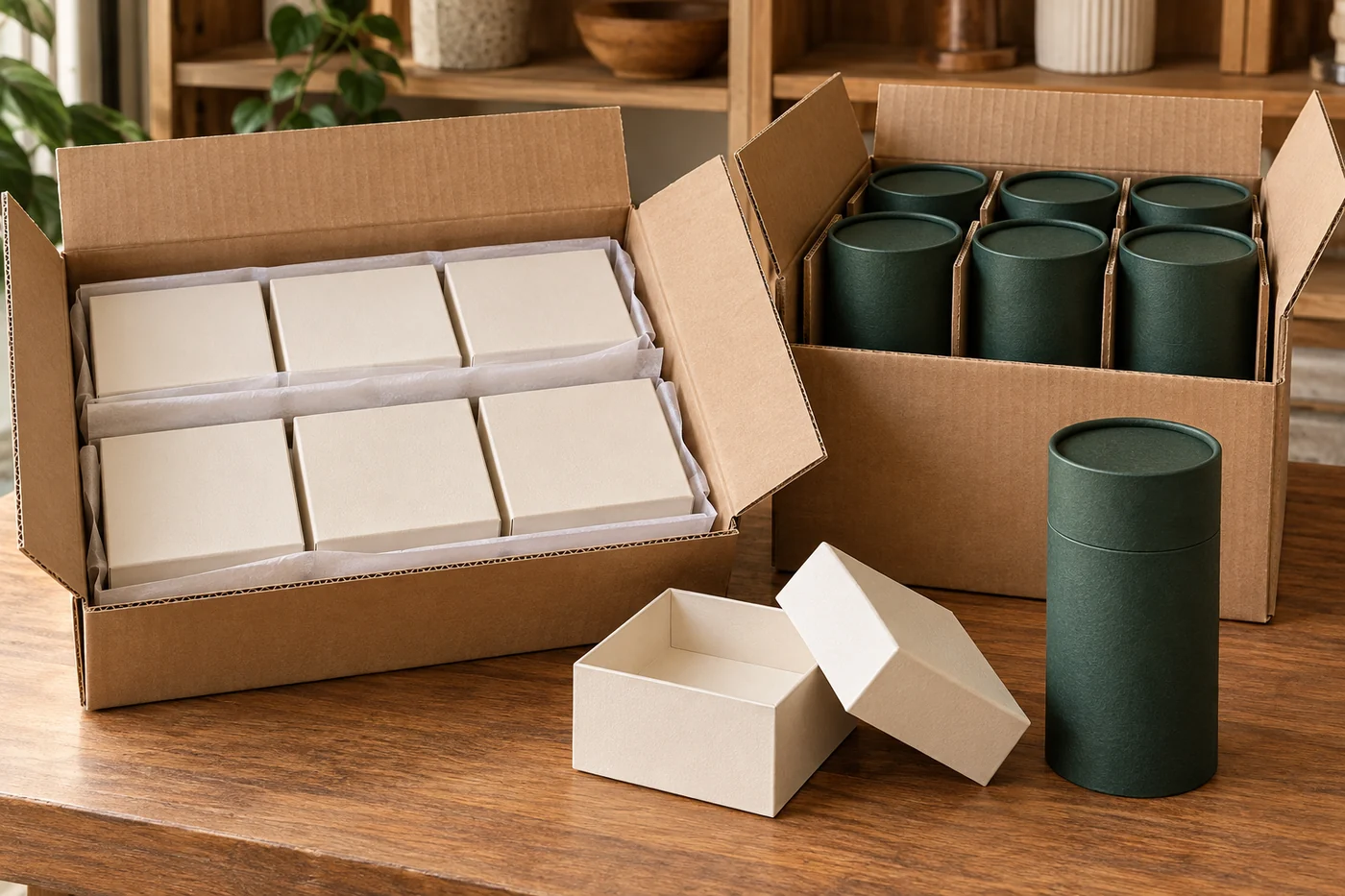
Request a packed-case trial rather than estimating capacity from a retail-box drawing. Measure the closed outer case with its actual contents and protection. Record its unit count and gross weight. If several case sizes are used, calculate each separately and add their volumes.
For a simple comparison, divide total external master-case volume by the quantity of packaging supplied. This is a planning ratio, not a carrier billing rule. Keep the quantity definition consistent: complete gift-box sets should not be compared with a count that includes lids, bases and inserts as separate finished units.
Consider two hypothetical packing proposals for 1,000 units, each using ten cases of 100 units. Ten cases at 60 × 40 × 40 cm occupy 0.960 m³ in total. Ten cases at 50 × 35 × 25 cm occupy 0.4375 m³. The second proposal uses approximately 54.4% less case volume. This arithmetic does not establish that either capacity is achievable for your design.
For warehouse planning, add the actual pallet or shelf constraints. A case-volume total does not include every aisle, pallet, handling clearance or partially filled location. For operational comparisons, also track the quantity accepted as usable; an arrangement that damages packaging can make the apparent density advantage misleading.
Check lids, inserts and tubes as part of the packing proposal
Separating components sometimes improves packing efficiency, but it creates a receiving and assembly task. The supplier should show how lids and bases are protected, which components arrive together, and how complete sets are counted. Do not propose nesting parts until their geometry and surfaces have been checked.
For coordinated rigid paper boxes and removable-cap tubes, compare the proposed master-case arrangement for each format. Tube diameter, cap overlap and dividers affect the arrangement. A cylindrical retail shape does not itself demonstrate better shipping density than a rectangular box.
Protect printed surfaces where they contact neighboring packs. Foil, textured paper and dark finishes deserve a packing trial with the proposed separators or interleaving. Reducing the number of protective layers without checking abrasion can exchange freight savings for rejected retail packaging. This article’s density calculation does not replace transport testing.
Include the cost of assembly and usable inventory
Compare the whole decision: packaging purchase, freight, receiving, storage, erection or assembly, and any observed rework. Use your own measured times and costs. Do not adopt a universal labor allowance or an assumed defect percentage just to make one structure appear cheaper.
A practical pilot starts with the packaging in its proposed delivered state. Have the intended team build and load a small batch using the actual products and components. Record time per accepted pack, common errors and space needed for work in progress. Include opening bundles and disposing of shipping materials where they materially affect the operation.
For seasonal chocolate bar packaging, peak storage can matter more than average annual usage. Map when empty packaging arrives, when it becomes finished goods and how much must remain available for the campaign. A large low-unit-price order can create avoidable stock if the artwork or demand changes.
Choose delivery splits using a stock plan
Smaller deliveries may reduce the maximum quantity held, but each dispatch can add minimum freight charges and receiving work. Ask for both a single-shipment quote and a defined split-delivery quote. State who holds the remaining packaging, for how long, under what conditions and with what responsibility.
When buying custom printed Christmas chocolate gift boxes, compare deliveries against your actual packing dates. A split that arrives after the seasonal packing window has little value even if it saves storage. Lead-time variability and emergency replenishment need their own allowance in your plan.
A useful trigger is the stock required until the next delivery plus the buffer you choose for uncertainty. Establish that buffer from your demand and supply history. Do not infer it from a packaging supplier’s general production-time statement, and keep production time separate from transport and receiving time.
Approve a shipping-pack specification alongside the retail design
The packed-case trial should become a repeatable specification. Otherwise, a later shipment may use larger cases, a different unit count or an additional protective layer that changes the volume. Record the agreed packing revision and require changes to be explained before shipment.
- Confirm the retail construction, supplied state and components included per complete unit.
- Record master-case external dimensions, units per case and measured gross weight.
- Include partial cases, component-only cases and their separate dimensions.
- Document interleaving, dividers, orientation and protection of decorated surfaces.
- Obtain pallet dimensions and height where the shipment is palletized.
- Request the forwarder’s applicable charging basis, measurement rules and exclusions.
- Compare receiving and assembly effort with the intended packing team.
- Confirm the order quantity, delivery split and peak storage requirement.
Before booking freight, reconcile the final packing list against this specification. Treat a difference in case count or dimensions as a reason to recalculate the shipment, not as an administrative detail. Photographs help explain the arrangement, but they do not replace measured dimensions and counts.
Frequently asked questions
Will reducing board weight lower the freight bill?
It may affect gross weight, but it will not necessarily change dimensional weight. Identify the charging basis first. Material changes also require a new performance review; a lighter pack that fails handling is not a useful saving.
Can every magnetic gift box ship flat?
No. Magnetic closure describes the closing feature. Flat supply requires a construction designed for collapse and erection. Ask for the actual supplied sample and assembly sequence rather than assuming a magnetic box is collapsible.
Should we remove inserts to fit more boxes per case?
Compare fitted and separate-component packing where feasible. Keep product support and presentation requirements intact, and count complete sets. Separate inserts can add sorting, assembly and component-storage work.
What should we send for a space-saving packaging quotation?
Send the product dimensions, intended retail structure, quantities, delivery destination and packing method. Add the current case sizes, counts, gross weights and storage constraint if available. Request a packaging and shipping-pack comparison from PaperBoxPro with a baseline and a clearly described alternative, then verify both through a packed-case trial.
Editorial note: Prepared with AI assistance and model-based source review. Images are AI-generated concepts; examples are hypothetical and do not document customer orders, factory procedures or verified shipping capacities.