
Plan custom gift set packaging around the unit you actually sell. Keep individual retail cartons inside the gift box when the same stock must also support single-item sales. Consider placing products directly in a fitted insert when the assortment is stable and a separate retail carton adds little useful protection or information. Compare a hybrid layout when only some components need their own boxes. Approve the complete packed set before choosing a route.
This decision comes before selecting a magnetic lid or gold foil. It determines which inventory you can share, how large the outer box becomes, what the packing team handles, and what remains with each item after the gift is opened. A beautifully decorated box can still be the wrong purchasing choice if it locks ordinary retail stock into an inflexible assortment.

Define the sales unit before the packaging structure
Write down whether the project is a fixed gift set, a customer-selected bundle, or a seasonal combination assembled from normal retail items. Then identify which components are already complete saleable units. A sealed bottle, a wrapped chocolate bar and a boxed accessory do not have the same packaging needs.
Separate three layers in the brief: primary packaging that contains the product, individual presentation packaging, and the common gift box. Removing an individual presentation carton is a different decision from removing a necessary primary container or wrapper. This article concerns presentation architecture; it does not establish food-contact suitability or product-label compliance.
For example, a range using custom chocolate candy-bar packaging may sell one wrapped bar in its own printed carton throughout the year. A gift assortment could retain that carton or use a different presentation around the wrapped bars. Start by confirming whether buyers need to redistribute or sell the constituent items separately.
Compare three gift box packaging configurations
| Configuration | Useful when | Main trade-off to check |
|---|---|---|
| Individual cartons inside an outer gift box | Gift and single-item orders share finished retail stock | More layers and larger outer dimensions may be needed |
| Primary-packed products directly in a fitted insert | The set composition is stable and individual presentation cartons are unnecessary | Requires its own fit, information and handling review |
| Hybrid arrangement | Some products need cartons while others can sit in the insert | Different heights and access requirements complicate the layout |
These are starting options, not universal cost rankings. A direct-to-insert arrangement may remove a carton but require a more involved tray. A carton-within-box arrangement may use more material while simplifying stock allocation. Ask for both a packaging quotation and a realistic packing method.
Retain individual cartons when shared stock matters
Gift set packaging with individual boxes lets the packing team select existing retail units before placing them in the common pack. This can be useful when demand shifts between singles and sets, provided the stock has not already been irreversibly committed to finished gift packs. The benefit is flexibility in allocation, not a promise of lower total cost.
A custom book-style gift box with magnetic closure can provide a shared opening experience around those retail units. Size the tray around the actual cartons, including seams, closures and dimensional variation. Do not develop cavities from the bare bottle dimensions if the bottle will arrive in a retail carton.
Use direct inserts when the set is a distinct presentation
For a stable collection, custom gift box inserts can hold the primary-packed products without an additional presentation carton. This may make more of each product visible when the lid opens. Check the real contact surfaces, retrieval space and closure clearance; a visually tidy cavity is not enough to establish handling suitability.
For a coordinated range of lift-off rigid gift boxes and removable-cap paper tubes, an individual tube can remain a standalone format while the gift box uses a different internal arrangement. Ask whether sharing artwork and visual cues is more useful than forcing both sales formats to use identical components. Confirm each format’s fit independently.

Build the layout around removal and replenishment
List the largest packed dimensions and weight of every component, its orientation and the area that should face the recipient. Measure the unit in the state that will be packed: with its wrapper, retail carton, cap or other retained components. Record which dimensions are provisional so the supplier can avoid treating them as frozen tooling inputs.
Sketch the removal sequence. Can the recipient grip the smallest item without tipping a heavier neighbor? Can the packer load the last cavity without crushing an adjacent carton? Does the lid contact a tall cap or raised carton flap? These questions apply to rigid gift boxes with inserts as well as folding gift cartons.
A useful sample review includes three conditions: the full set, the first item being removed, and the pack after one item is gone. The last condition reveals whether neighboring products become awkward to handle. This is a functional check, not a substitute for distribution testing.
For corporate gift packaging assembled close to dispatch, also decide which parts can arrive preassembled. Ask the supplier and fulfilment team to demonstrate the proposed loading sequence with representative components. Count separate handling operations instead of assuming that fewer packaging pieces always mean faster packing.
Keep seasonal graphics separate from permanent retail identity
Decide which layer owns the occasion. The year-round product carton can carry its normal identity while the outer pack creates the seasonal presentation. Alternatively, a dedicated seasonal carton may be appropriate when it will also be sold individually. Make that choice before producing artwork for every layer.
With festive printed chocolate-bar cartons, compare a fully seasonal individual design against a permanent individual design inside a seasonal gift box. The first can support standalone holiday sales; the second can preserve a shared retail component. Neither eliminates the need to plan what happens to unused printed packaging after the event.
A separate Christmas chocolate-bar gift box design is another reference for deciding how much occasion-specific artwork the individual pack needs. If your order already includes this dedicated seasonal unit, specify whether it is a finished saleable item to be grouped or a component developed only for the assortment. Do not assume one drawing covers both uses.
For foil stamped gift boxes, identify the decoration that stays constant across editions and the printed areas that change. Ask whether the proposed construction allows selective artwork updates without redeveloping unaffected parts. Confirm setup charges and material commitments; shared appearance does not automatically mean shared tooling or a combined minimum quantity.
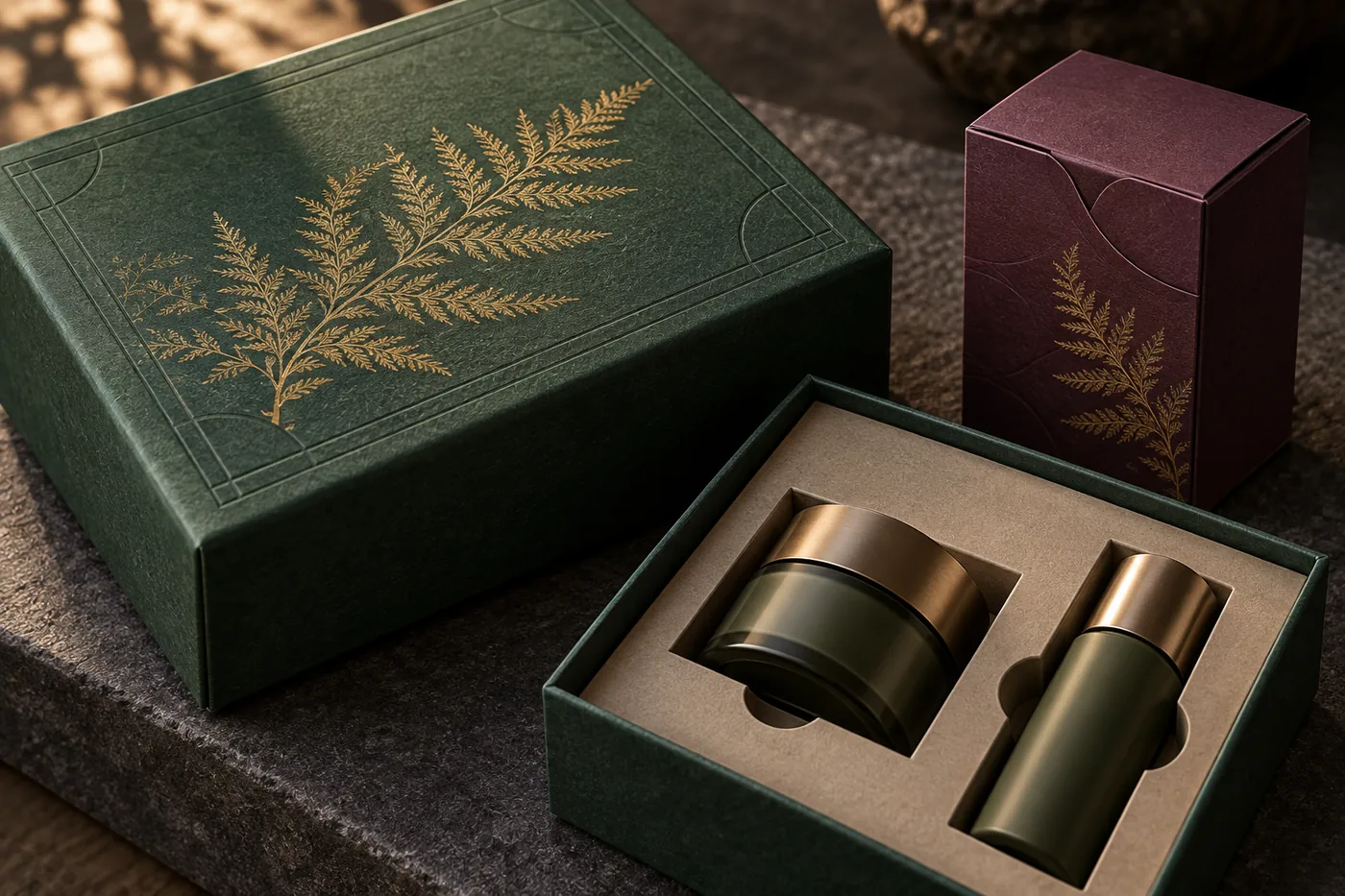
Check the identity of the set and its constituent items
Keep the outer set’s product identity distinct from the identities of its contents. GS1’s guidance on multi-packs and bundles distinguishes a newly created physical bundle from a virtual bundle and explains their different GTIN treatment. Have the brand’s product-data owner confirm the applicable identification before artwork approval rather than reusing a component barcode by assumption.
In the packaging brief, identify the intended outer label area, which individual codes should remain accessible during assembly, and what the warehouse scans at dispatch. Ask the relevant retail or fulfilment partner how it handles visible component codes. This guide does not prescribe a universal barcode-covering method or replace the channel’s requirements.
If products will later leave the set and be sold individually, confirm that each unit retains the information and packaging it needs for that use. Keep this review separate from the visual layout. A gift box that looks complete when closed may contain items that are unsuitable for the proposed standalone sale.
Compare total packed-set cost on the same basis
For wholesale gift set packaging, compare the same assortment, delivered condition and quantity. Include the common box, inserts, retained individual cartons, assembly, any separate labels, master shipping cases and delivery. Separate development and tooling from recurring unit costs. Otherwise one quotation may appear cheaper simply because it excludes a layer or transfers assembly work to your team.
Use a packaging bill of materials with a quantity per set. If a set contains three boxed bars, enter three individual cartons, one common box and the required divider components. Where those individual cartons also support single-item sales, show the shared stock separately from the quantity already committed to gift sets. This avoids counting the same available cartons twice.
Request a second price only when it represents a useful alternative: for example, the same products directly in a tray rather than in individual cartons. Record what protection, information, assembly or presentation changes with that alternative. A lower box price is not a like-for-like saving if it changes the sales unit you intended to supply.

Approve the full assortment, then its delivery pack
Review a complete gift set with representative contents, not just an empty decorated shell. Check orientation, removal, lid closure, visual balance, packing sequence and the set’s identification. Record the exact product and packaging revisions represented by the sample.
Next, review the gift set inside its intended shipping configuration. ISTA’s design and testing guidance emphasizes the packaged-product system and the supply-chain hazards it must face. An attractive magnetic box is not, by itself, evidence that the packed assortment will survive parcel delivery. Agree on suitable validation with the responsible packaging specialist or test provider; do not copy an arbitrary drop height from another project.
Freeze the approved assortment and define how changes are reviewed. Replacing a jar with a taller bottle, adding a retail carton or changing the number of bars can affect the layout and packed result. Identify who approves the change before the packing team improvises around an obsolete tray.
Buyer checklist for a useful gift-set quotation
- Sales model: fixed set, selectable assortment, or seasonal bundle; identify any standalone sales.
- Contents: quantity, weight and dimensions of each unit in its actual packed state.
- Architecture: individual cartons retained, direct insert, or hybrid; keep necessary primary packaging.
- Layout: orientation, product-facing panels, access and loading sequence.
- Graphics: permanent versus occasion-specific layers and approved finishing references.
- Operations: who assembles the set, delivery condition and stock-allocation method.
- Identification: set and component codes, information review and dispatch handling.
- Validation: representative full-set sample, shipping configuration and change-approval owner.
Frequently asked questions
Can one gift box size serve several assortments?
Possibly, if the actual combinations fit and each internal arrangement is validated. Ask whether interchangeable inserts make operational sense. Do not assume unused cavities or loose filler will give the same presentation and restraint for every assortment.
Is removing the individual carton always cheaper?
No. Compare the cost of the revised insert, handling, artwork, information and delivery configuration. Removing a presentation layer is useful only when the remaining system still meets the product and sales requirements.
Can we use the same packaging for retail and corporate gifts?
Often the product identity can be coordinated, but the sales unit and packing process may differ. Define what is genuinely shared and what is specific to the gift set before combining quantities or approving artwork.
What should we send for custom gift set packaging?
Send the contents list, packed product measurements, standalone retail requirements, quantity by assortment, visual references and delivery destination. Discuss a custom gift-set packaging brief and request a quotation that separates the outer box, inserts, individual cartons and assembly scope.
Creation note: Prepared with AI assistance and model self-review using the linked official guidance and product descriptions. Examples and generated images are concepts, not customer cases, production specifications or test results. Confirm project-specific materials, feasibility and requirements before ordering.