
Choose lamination when the box needs a continuous film surface and stronger resistance to routine handling; choose an aqueous coating when a folding carton needs efficient all-over protection with relatively light surface build; choose an overprint varnish when the job needs a controlled printed coating, selective coverage, or a finish that fits a particular press route. Do not choose from the words “matte” or “gloss” alone. The right custom box surface finish depends on the board, ink, folds, glue zones, decorative processes, packing conditions, exposure risks and end-of-life requirement.
This guide is for packaging buyers comparing finish routes before sampling. It does not certify food contact, recyclability, moisture resistance or regulatory compliance. Those outcomes depend on the exact finished construction, supplier declarations, intended market and appropriate testing.
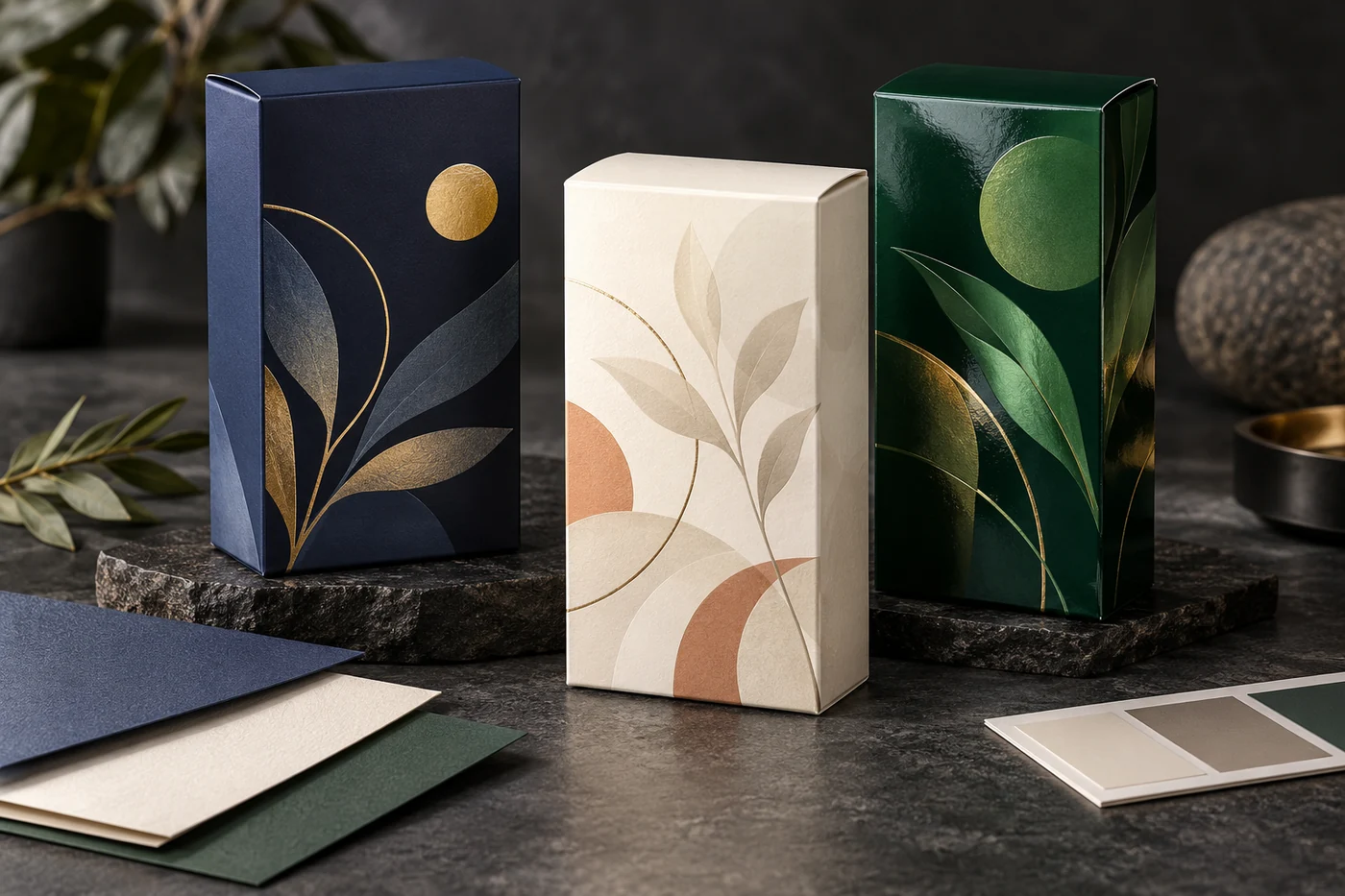
Start with the failure you need the finish to prevent
A surface finish is not simply decoration. Write down the commercial problem first: ink rubbing during packing, fingerprints on a dark box, scuffing in a master carton, occasional splashes at retail, a required gloss level, or the need to protect graphics while keeping folds and glue areas workable. A finish selected only from a photograph may solve the appearance brief and create a converting problem.
Separate appearance from performance. “Soft matte” describes a visual and tactile direction. “No visible ink transfer after the agreed rub check” describes an outcome. Both can be important, but they are not interchangeable. Ask the converter to identify the finish chemistry or film, application method, coverage, gloss target where relevant, and the sample or test used for acceptance.
Lamination, aqueous coating or varnish: a purchasing comparison
| Decision factor | Film lamination | Aqueous coating | Overprint varnish |
|---|---|---|---|
| What is added | A separate film bonded to the printed sheet | A water-based liquid coating applied and dried | A clear printed or coated layer, with chemistry chosen for the press route |
| Common reason to shortlist | Continuous feel, visual depth and robust handling surface | Efficient all-over protection on folding cartons | Targeted protection, gloss control or selective application |
| Typical appearance range | Gloss, matte, soft-touch and specialty films | Gloss, satin or matte, depending on formulation | Gloss, matte or special effects, depending on formulation and application |
| Key production risk | Fold cracking, delamination, trapped appearance defects, difficult glue zones | Drying, blocking, curl, coating uniformity and compatibility with later operations | Rub resistance, cure or drying, odor, yellowing and compatibility |
| Coverage question | Usually continuous over the laminated area | Often flood-coated, but coverage must be specified | Can be flood or selective, depending on method |
| End-of-life question | Film and adhesive become part of the construction | Ask how the exact formulation affects the intended recycling stream | Ask the same question for the exact varnish and applied weight |
These are selection tendencies, not guarantees. Coatings are formulated for specific applications. For example, an ACTEGA technical data sheet for one aqueous matte folding-carton coating lists its particular substrate recommendation, application routes and compatibility notes, and explicitly recommends preliminary trials. That is why “aqueous coating” alone is not a complete specification.
Choose film lamination for a continuous premium surface
Lamination is a logical starting point when the brand wants a continuous matte or gloss character, the printed surface will receive frequent handling, or the box needs a more substantial surface feel. A laminated custom book-style magnetic gift box can use the film as part of a coordinated luxury finish, but the buyer should approve the wrapped corners, hinge, foil adhesion and scuff behavior—not only a flat printed sheet.
Film is not automatically the strongest answer for every package. Tight folds can stress the decorated sheet. Glue may need a prepared or unlaminated area. A soft-touch surface can show marks that a conventional matte film hides. Dark colors may reveal polishing or scratches differently from pale artwork. Ask for the complete converted sample and inspect high-contact edges under both diffuse and raking light.
For a coordinated set using luxury paper boxes and tubes, repeat the finish comparison on both the flat box panels and the curved tube wrap. The same nominal film can look different over different substrates and geometries. Approve each construction rather than assuming one sample represents the whole range.

Choose aqueous coating for efficient folding-carton protection
An aqueous coating is often shortlisted for high-volume folding cartons that need all-over sheen control and protection without adding a separate film layer. It can fit an inline production route, but the precise result depends on coating formulation, coat weight, board absorbency, ink system and drying conditions. “Water-based” describes the carrier system; it does not by itself prove recyclability, food suitability, low odor or resistance to every liquid.
This route can suit compact cartons such as custom flip-top cigarette boxes, where the finish must coexist with repeated folds, a lid hinge, optional foil and tightly controlled graphics. Ask whether the coating covers fold lines, whether foil is applied before or after it, and whether the side seam or other glue area is knocked out. The production sequence determines the compatibility question.
Aqueous does not mean “one universal coating.” Suppliers formulate for gloss, matte, slip, scuff resistance, heat exposure, further printing and other requirements. Request the product family or performance description actually proposed for your job and have the converter confirm compatibility with the selected ink, board and later finishing.
Choose varnish when coverage and press route need flexibility
Overprint varnish can be useful when the buyer wants an economical protective layer, a specific gloss level, or selective coverage that leaves glue, write-on or later-decoration zones untreated. Depending on the press and formulation, the varnish may be oil-based, water-based or energy-curable. Therefore, “varnish” is also incomplete without its chemistry, coverage and cure or drying method.
For custom disposable vape cartons with dense color, warnings, barcodes and optional spot effects, map which areas need protection and which must remain readable, scannable or available for another operation. A flood protective varnish and a decorative spot gloss solve different problems. Do not assume that the presence of a shiny area proves adequate rub protection over the rest of the box.
Similarly, wholesale custom vape packaging boxes may span folding cartons and rigid structures. State the actual substrate and print route in the RFQ. A varnish specified for coated folding boxboard is not automatically the right surface treatment for a wrapped rigid box or a heavily textured paper.

Plan folds, glue, foil and embossing as one sequence
A finish changes the surface that later operations must grip, deform or bond to. Mark the side-seam glue flap, lock tabs, fold scores, window-gluing area and any label or seal position on the production dieline. Ask the converter which zones must be left untreated or specially prepared. This is especially important when the package combines lamination or coating with hot foil, cold foil, spot UV, embossing or debossing.
The correct sequence varies. A coating may accept a later foil only after the supplier has confirmed the compatible materials and operating window. A glue that works on bare board may not bond reliably to a film. An embossed region can change surface reflection and expose cracking at a deep score. Treat each combination as a system and require a decorated sample made in the proposed order.
Do not turn a decorative finish into a compliance claim
Food, pharmaceutical, tobacco and other sensitive packages require additional review. An attractive coating on the outside does not establish that the whole package is suitable for direct food contact, controls migration, or meets a market-specific rule. Sun Chemical’s folding-carton guidance for inside and outside printing notes that direct-contact applications need more caution and that ordinary low-migration or low-odor systems are not automatically sufficient.
For custom chocolate bar packaging, identify whether the paper box is secondary packaging around a sealed primary wrapper or whether any printed surface could contact food. Give that use case, the target markets and expected temperatures to a qualified supplier or compliance specialist. Request declarations and testing for the exact ink, coating, adhesive, board and construction—not a generic statement about “food-grade paper.”
Approve performance with production-intent samples
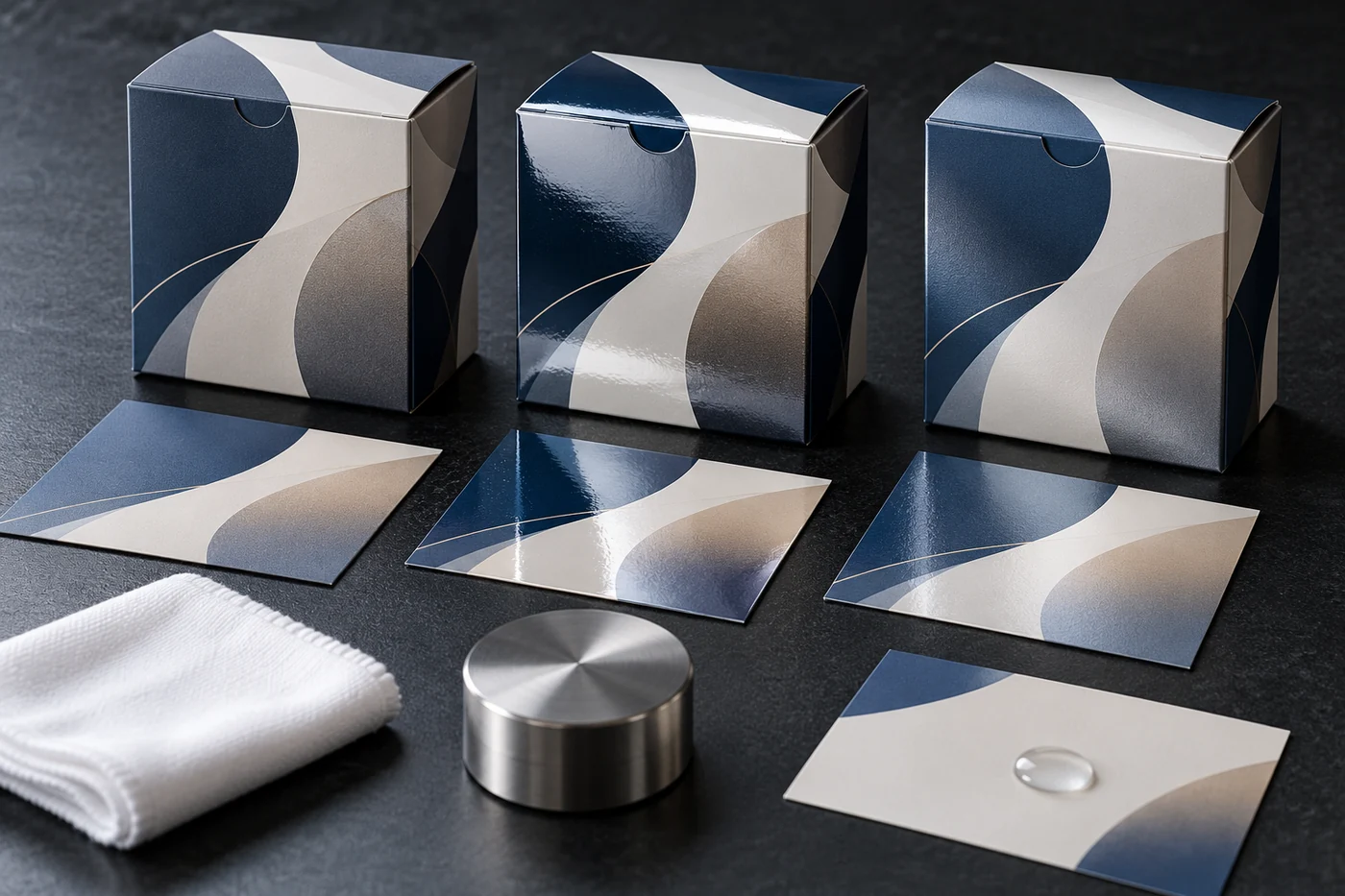
A screen image cannot demonstrate gloss, friction, scuffing, blocking, fold durability or resistance to handling. Use a staged approval plan:
- Finish swatches: compare candidate surfaces on the intended printed board, including dark and light artwork.
- Converted sample: inspect scores, corners, glue seams, closures and decorated areas after folding.
- Packing trial: run the finished cartons through the real hand-packing or automated sequence and record cosmetic damage.
- Defined exposure checks: agree the rub, scratch, splash, temperature or stacking conditions that reflect actual distribution.
- Approved reference: retain a dated sample and the written finish specification for production and reorders.
If abrasion matters, use a method and acceptance threshold agreed before the test. ISO 18947-1:2021 specifies general rub-testing methods for analogue and digital prints, but citing a standard number is not the same as defining the specimen, apparatus, cycles and pass criterion for your package. The buyer and converter need a reproducible instruction tied to the real risk.
An RFQ checklist for custom box surface finishes
- What board, visible paper, ink system and printing process are proposed?
- Is the finish a film, aqueous coating or varnish, and what appearance should it create?
- Which failure is it meant to prevent: rub, scuff, fingerprints, splash exposure or something else?
- Is coverage flood or selective, and which glue, fold, foil, label or write-on zones must remain untreated?
- What operations come before and after the finish?
- Which production-intent sample and performance checks will determine acceptance?
- What declarations are needed for food, regulated products or target-market requirements?
- How does the complete construction fit the brand’s documented end-of-life claim?
Frequently asked questions
Is aqueous coating always more recyclable than lamination?
No universal claim is safe. Recyclability depends on the complete package, the exact coating or film and adhesive, applied amounts, contamination and the collection and reprocessing system available in the target market. Ask for evidence relevant to the finished construction and market.
Does matte lamination prevent fingerprints?
Not necessarily. Surface chemistry, color, handling and light angle affect visibility. Some matte and soft-touch surfaces show oils or polishing clearly. Compare handled samples on the actual dark and light artwork.
Can foil stamping go over an aqueous coating?
Sometimes, but compatibility must be confirmed for the exact coating, foil, adhesive system and production sequence. A coating supplier’s guidance may require trials, and the converter should approve the combination before bulk production.
Is a gloss varnish the same as spot UV?
No. “Gloss varnish” is a broad description, while spot UV refers to an energy-cured coating applied selectively. The film thickness, gloss contrast, registration, cure and cracking risk can differ. Specify the intended process and coverage.
Request two finish routes, not one vague “premium” option
Ask the converter to quote a practical baseline and a higher-protection or higher-impact alternative on the same box, board, artwork and quantity. Compare the decorated samples after folding, packing and agreed handling checks. That makes the tradeoff among appearance, protection, converting risk, cost and end-of-life easier to evaluate.
To prepare a finish comparison, send PaperBoxPro your box style, board preference, artwork coverage, target quantity, sensitive zones, packing method and expected exposures through the custom packaging enquiry page. Request that each proposal name the surface system, coverage, production sequence and sample approval plan.
Image note: the illustrations in this article are AI-generated packaging concept visuals. They are not production samples, engineering dielines, customer projects, laboratory results or evidence of certified performance.