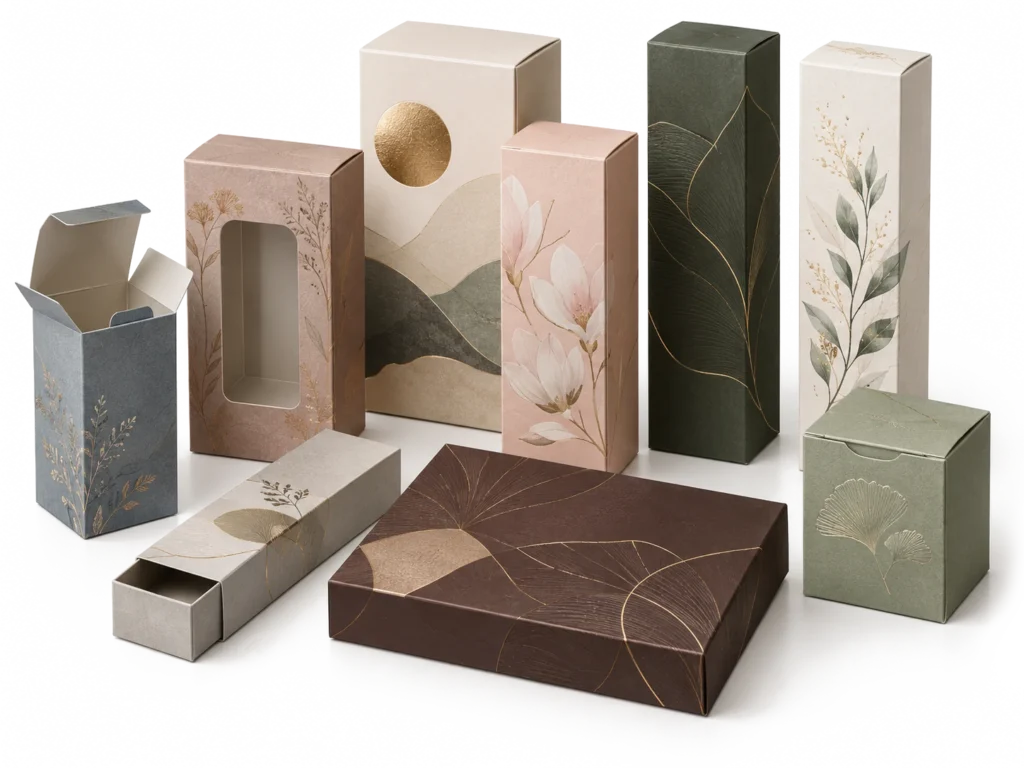
Print the inside of your custom box when that surface has a clear job after opening: presenting the brand, explaining the assortment or completing a gift reveal. Leave it plain when products, inserts or wrappers hide most of the area, or when the message changes faster than the packaging stock. A selective inside-lid design, a plain lining or a separate card may deliver a better result than printing every internal panel.
For brand buyers, chocolatiers and corporate-gift suppliers, the decision should start with the loaded package. An empty rendering makes all interior surfaces look valuable. In use, a tray may cover the floor, products may hide the pattern and a narrow flap may appear only for a moment. This guide helps define what deserves decoration, which component receives it and how to compare quotations before approving interior printing.

Map what customers actually see
Review the package in three states: fully loaded, partly unpacked and empty. Photograph each state from the normal opening position. Mark the surfaces that remain visible, those revealed only when an item is removed and those normally hidden behind an insert. Use that simple visibility map to assign the printing budget.
In a book-style gift box with a hinged opening, the inside lid can provide a relatively large display area while the loaded tray covers much of the base. For a cosmetic gift set, a restrained pattern or short permanent brand message on the lid may be sufficient. Printing beneath an insert has little presentation value unless the buyer deliberately wants that later reveal.
Do not hide necessary product information in a decorative area that recipients may never see. Have the brand’s information owner decide where required instructions and product details belong. Interior decoration should support the package’s communication plan rather than become a reason to relocate information without review.
Choose the right level of interior decoration
| Route | Useful condition | What to check |
|---|---|---|
| Plain interior | Contents dominate the reveal or the inside is rarely visible | Actual shade, clean appearance and exposed edges in the loaded sample |
| Selective printing | One lid, flap or back panel carries a useful permanent message | Visibility, orientation and the quoted setup scope |
| Coordinated all-over design | Multiple visible surfaces contribute to a deliberate presentation | Pattern alignment, folds, seams and finished handling appearance |
| Plain interior plus separate card | Campaign details change while the box remains common stock | Card cost, placement, packing work and version control |
These are purchasing routes, not a universal price order. A small printed area can still require a separate setup. A plain-looking rigid-box interior may still need lining paper and assembly. Ask which materials and operations change, rather than estimating savings from the percentage of white space in a mockup.

Identify the component being printed
Folding cartons: inspect the reverse face of the board
For a folding carton, the inside normally comes from the reverse face of the sheet used to form the box. Specify the proposed board grade and which face receives the artwork. Do not assume that a clean white inside has the same coating or printing surface as the outside.
Holmen Iggesund’s paperboard packaging guidance, tip 5 explains that some solid bleached board products have a lightly coated reverse to support ink distribution and printing on both faces. The key word is some: the buyer still needs the proposed grade and a representative printed sample. That guidance does not establish that a particular mill product is stocked or used by NEXA.
For custom printed chocolate-bar cartons, compare a plain reverse, a small flap motif and a more extensive inside pattern with the actual wrapped bar in place. The inside flap may be the only useful reveal. Check the folded result before paying to decorate panels that remain covered throughout normal opening.
Rigid boxes: separate the lining from the structural board
A wrapped rigid box can involve outer wrap, supporting board, inner lining and an insert as separate components. Ask the supplier to identify where your inside artwork will be printed. An inside-lid image, a printed lining around the base and a printed top card over an insert are different quotation items.
The coordinated luxury box and paper-tube packaging collection includes a lift-off-lid box and a fitted insert. When evaluating that box format, assess the lid underside, exposed walls and visible insert separately. Do not assume that an inside-printing proposal for the box automatically applies to the tube; its internal construction and product-contact conditions need their own review.
Also distinguish plain from unfinished. A deliberately selected unprinted lining can provide a complete appearance. Leaving supporting board exposed is a different construction choice and should be shown explicitly in the sample and quotation.
Design around the reveal, folds and assembly
Place the important visual element where it survives the opening sequence. On a hinged box, check the message from the recipient’s side with the lid open. On a tuck carton, verify which flap opens first. On a lift-off lid, check whether the artwork is presented naturally or requires the user to turn the lid around.
Ask for interior and exterior views clearly identified on the approved drawing. Do not approve an unlabeled flat file and assume that everyone interprets its viewing direction the same way. Confirm pattern direction, finished panel boundaries and the position of any text in a folded sample.
Let the converter mark glue areas, turn-ins, seams, folds and other functional zones on the relevant artwork. Keep critical decoration away from those areas unless the proposed construction and sample support it. There is no useful universal offset to invent here; the approved drawing must show the applicable limits.
For holiday chocolate gift cartons with decorative finishing options, decide whether occasion-specific wording belongs inside the permanent box or on a separate card. A dated greeting printed inside otherwise reusable stock can make the whole packaging item campaign-specific. Keep that inventory consequence visible in the purchasing decision.
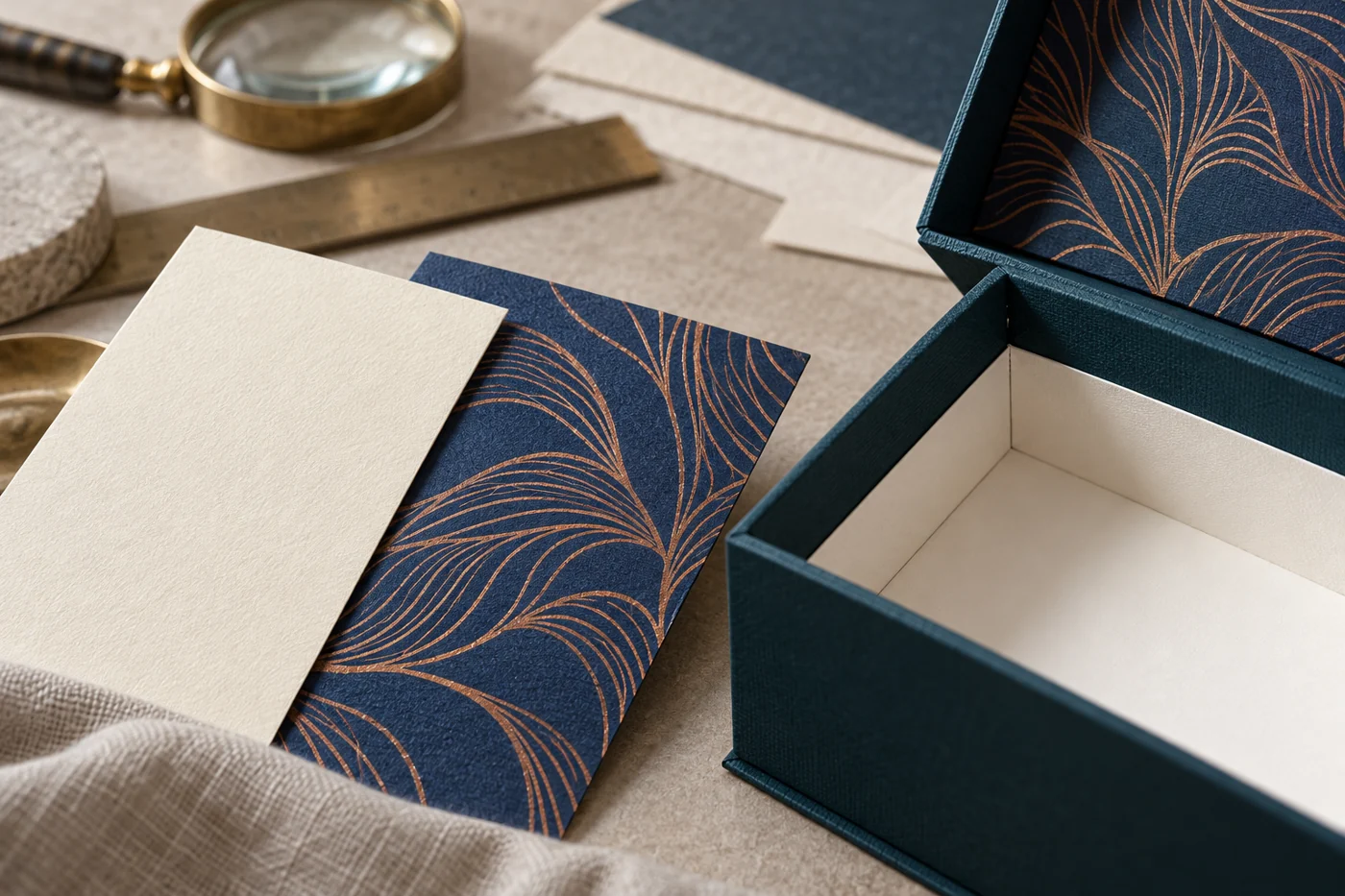
Judge the interior in its selling and handling context
An attractive empty interior is not enough. Load the intended products and inserts, close the box, open it normally and remove the contents. Check whether the decoration remains visible, the information is readable and the exposed lining still looks intentional. Agree which appearance conditions are acceptable before the order is released.
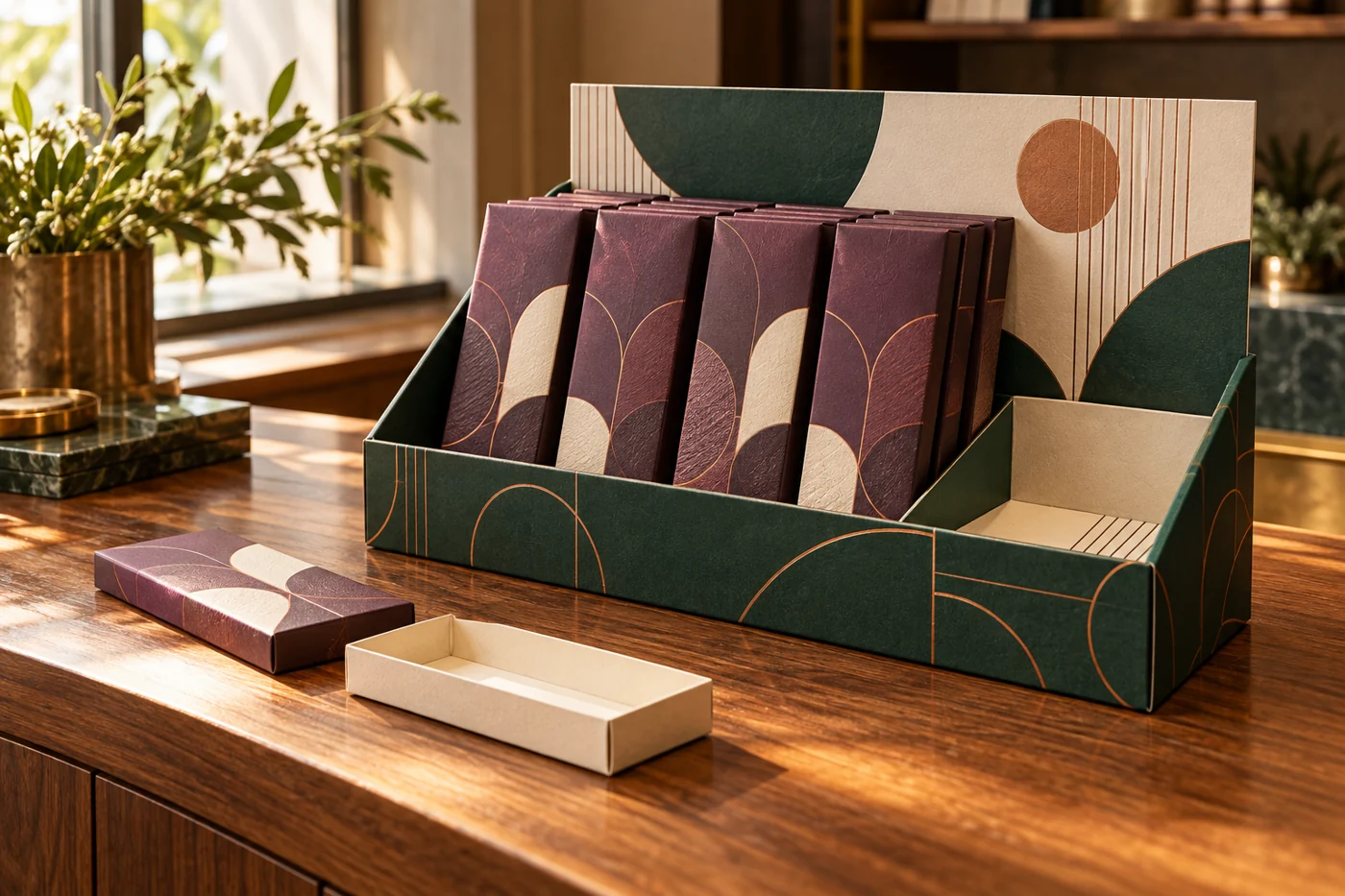
A countertop pack illustrates why the viewing state matters. With retail display boxes for wrapped bars and confectionery, the inside back wall may be visible while stocked, while the floor appears mainly after units sell. Compare the full, partly depleted and nearly empty display. Do not pay to print the floor solely because it dominates an empty-box rendering.
For presentation boxes, check contact between decorated surfaces and the packed components. Ask for an agreed handling trial using the proposed finished materials if rubbing, marking or transfer is a concern. Record the conditions and results rather than treating a beautiful sample photograph as proof of durability.
Keep product-contact suitability outside the decoration decision
State whether contents are sealed in their own containers or wrappers and which surfaces can touch them. If the project involves direct food contact, request a material and compliance review for the intended product, destination and use conditions before selecting the ink, lining or finish. Do not infer suitability from the words white board, plain paper or luxury packaging.
This article evaluates interior presentation, not the safety of a particular printed construction. No pictured concept establishes food-contact suitability, and no inside-printing route automatically qualifies a package for a regulated application. Keep those evidence requirements in the brief rather than trying to settle them through visual approval.
Compare quotations without hiding the extra work
Request the same box structure, dimensions, quantity, exterior artwork, insert and delivery condition for each alternative. Then itemize the changes for plain, selective and all-over interiors. Ask about board or lining-paper changes, printing setups, finishing, assembly and sample charges. Keep one-time development separate from recurring unit cost.
For the card alternative, include the card itself, any additional packing step, version identification and the possibility of incorrect insertion. A separate card is useful when it preserves common box stock, but it is not cost-free. Likewise, a printed interior may simplify the packing bill of materials while committing more inventory to one campaign.
Use your own forecast to compare the alternatives: quantity needed by design, likely repeat orders and what happens to unused boxes after the campaign. Avoid assuming a percentage uplift or saving without comparable quotations. The useful output is an agreed decorated construction and a transparent total scope.
Interior-printing sample approval checklist
- Identify the receiving component: carton reverse, lid lining, wall lining or insert top card.
- Record the proposed material grade, print face, artwork revision and finish.
- Inspect the package fully loaded, partly unpacked and empty.
- Verify artwork orientation from the normal opening position.
- Review folds, seams, edges, turn-ins and marked functional areas.
- Check readability, visible coverage and the relationship to product information.
- Agree any handling checks and separate product-contact evidence requirements.
- Retain an assembled reference and confirm what changes need renewed approval.
Frequently asked questions
Is inside printing necessary for a premium box?
No. A well-specified plain lining and organized contents can provide a complete presentation. Print the interior when the visible result or communication has a defined purpose, rather than treating coverage as a measure of quality.
Will the same artwork look identical inside and outside?
Do not assume it will. Identify the actual receiving materials and finishes, then approve the two surfaces together. A shared color name or digital preview does not approve the converted result.
Is a small inside logo always cheaper than an all-over pattern?
Not necessarily. Setup and production route still matter. Request itemized alternatives on the same construction and quantity, and compare what is included in each price.
Can we add interior artwork after approving the outside?
Ask before treating the exterior approval as final. Interior artwork may change the material, printing scope, lining or sample requirements. Confirm the revised quotation and complete assembled reference before production release.
Ask for an interior proposal that earns its cost
Send NEXA Packaging your product and packing arrangement, opening sequence, visible-area photographs, quantities and intended interior message. Request a plain baseline and a purposeful printed alternative, with the receiving component and sampling scope clearly identified.
NEXA Packaging is an actual factory manufacturing custom paper boxes and custom paper tubes. Factory-direct pricing reduces intermediary markups, while direct production communication supports cost control, scheduling and traceable quality responsibility. The factory directly follows up production quality and related issues. Regular production lead time is 7–15 working days, excluding shipping, with the order-specific schedule confirmed according to quantity, materials, structure, finishes and final approvals. These advantages should be assessed on comparable specifications rather than an unsupported promise to beat every trading company.
Editorial context: AI-assisted drafting and a separate model self-review using current product content and the linked primary paperboard guidance. Images are AI-generated design concepts, not factory photographs, customer orders, engineering drawings or test evidence. No human or laboratory review is claimed.