
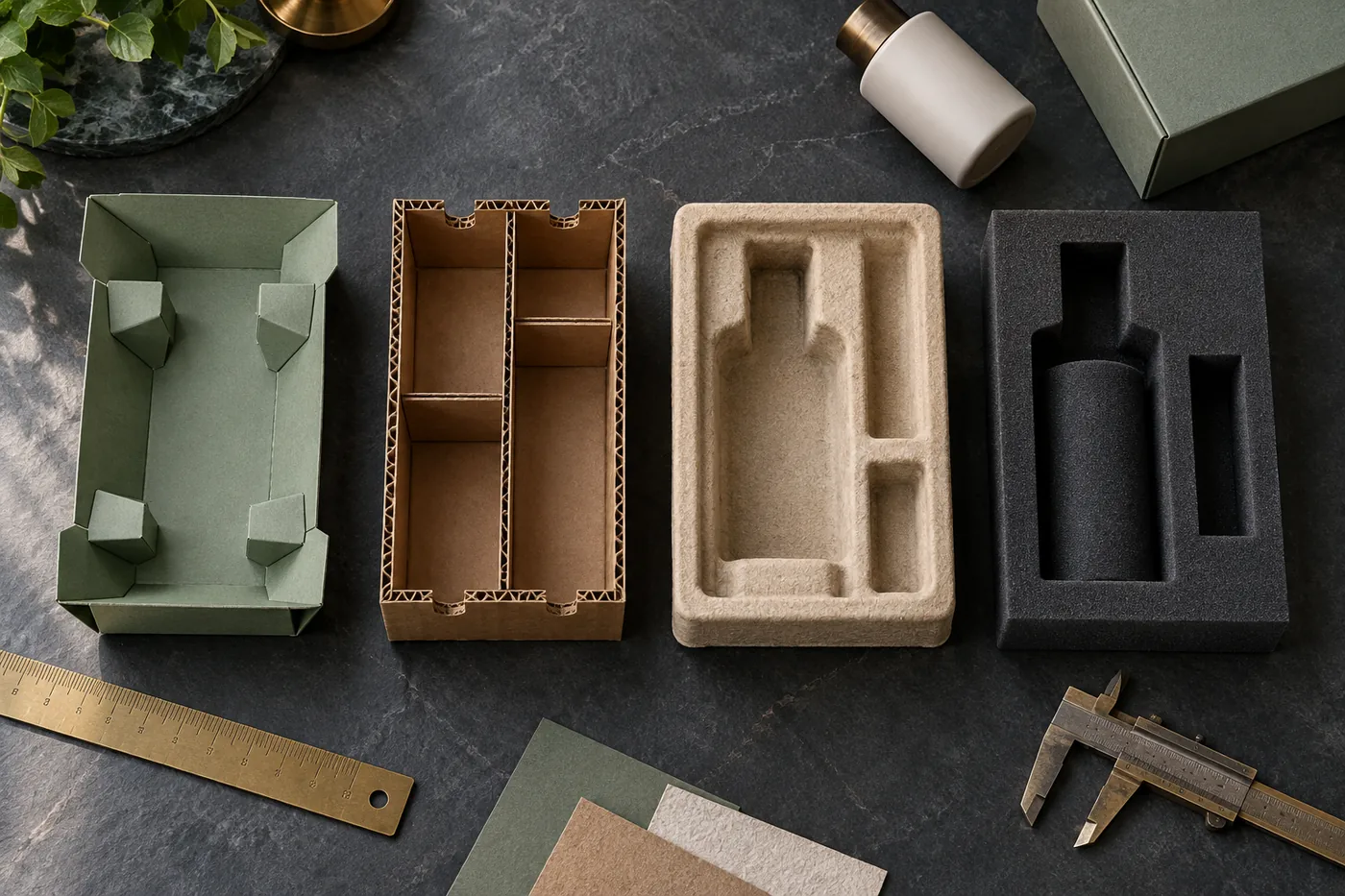
Choose the packaging insert material only after defining what the insert must do. Folded paperboard can suit light products and a print-led presentation; corrugated board can add depth and separation; molded fiber can form shaped pockets; EVA foam can create a dense, precise presentation; and thermoformed plastic can provide repeatable cavities and visibility. None is automatically the best choice. Product mass, fragile points, allowable movement, removal access, packing labor, outer shipping pack and the intended disposal route should decide the shortlist.
This guide helps a B2B buyer compare custom packaging inserts without turning a material name into a performance promise. A beautiful retail tray is not necessarily shipping protection, and a firm cavity is not useful if packers cannot load it or customers cannot remove the product.

Start with the insert’s job, not its material
Write a short insert brief before asking suppliers for samples. Identify every product, its finished dimensions and mass, surfaces that can accept pressure, fragile projections, preferred orientation and the points a customer may grip. Then state whether the insert is expected to organize products for retail, retain them when the box is tilted, cushion shock, separate components, hide accessories, or do several of those jobs.
Also separate the retail box from the distribution system. The outer shipper, void fill, case quantity and pallet pattern may carry much of the transport load. Official carrier packing guidance emphasizes restricting movement and filling voids in shipping packages, but that does not prove a fitted retail tray will protect a product in your route. Treat the insert, presentation box and shipping container as one system when protection matters.
Compare five packaging insert material routes
| Insert route | Often useful when | Questions before approval |
|---|---|---|
| Folded paperboard | Products are light, printed appearance matters and folded tabs can provide retention | Will the folds stay locked? Is there finger access? Do coatings, laminates or glued parts change the intended disposal route? |
| Corrugated board | More depth, separation or load distribution is needed inside a larger box | Which flute and edge direction are proposed? Are exposed edges acceptable for the presentation? |
| Molded fiber | A shaped tray, rounded contact surface or natural fibrous appearance fits the product and brand | What draft, wall thickness, surface finish, moisture condition and tooling route will the sample represent? |
| EVA or other foam | A dense, close-fitting premium tray is desired for a stable product geometry | What density and thickness are sampled? Can parts be removed easily? How will the insert be separated from the box after use? |
| Thermoformed plastic | Repeatable shaped cavities, thin walls or product visibility are important | Which polymer, gauge and finish are quoted? Are sharp edges controlled? Does the buyer’s destination have a practical recovery route? |
The table is a screening tool, not a substitute for a physical packaging insert sample. Two inserts made from the same nominal material can behave differently because of thickness, grain or flute direction, cavity geometry, adhesives, surface finish and how they are retained inside the box.
When folded paperboard is a strong starting point
Paperboard box inserts can use scored platforms, locking tabs, shoulders, bridges and dust flaps to organize light products. They can carry coordinated printing, which is valuable when the interior is part of the brand presentation. A single cut-and-creased blank may also arrive flat and be erected during packing, but only if the folding sequence is reliable.
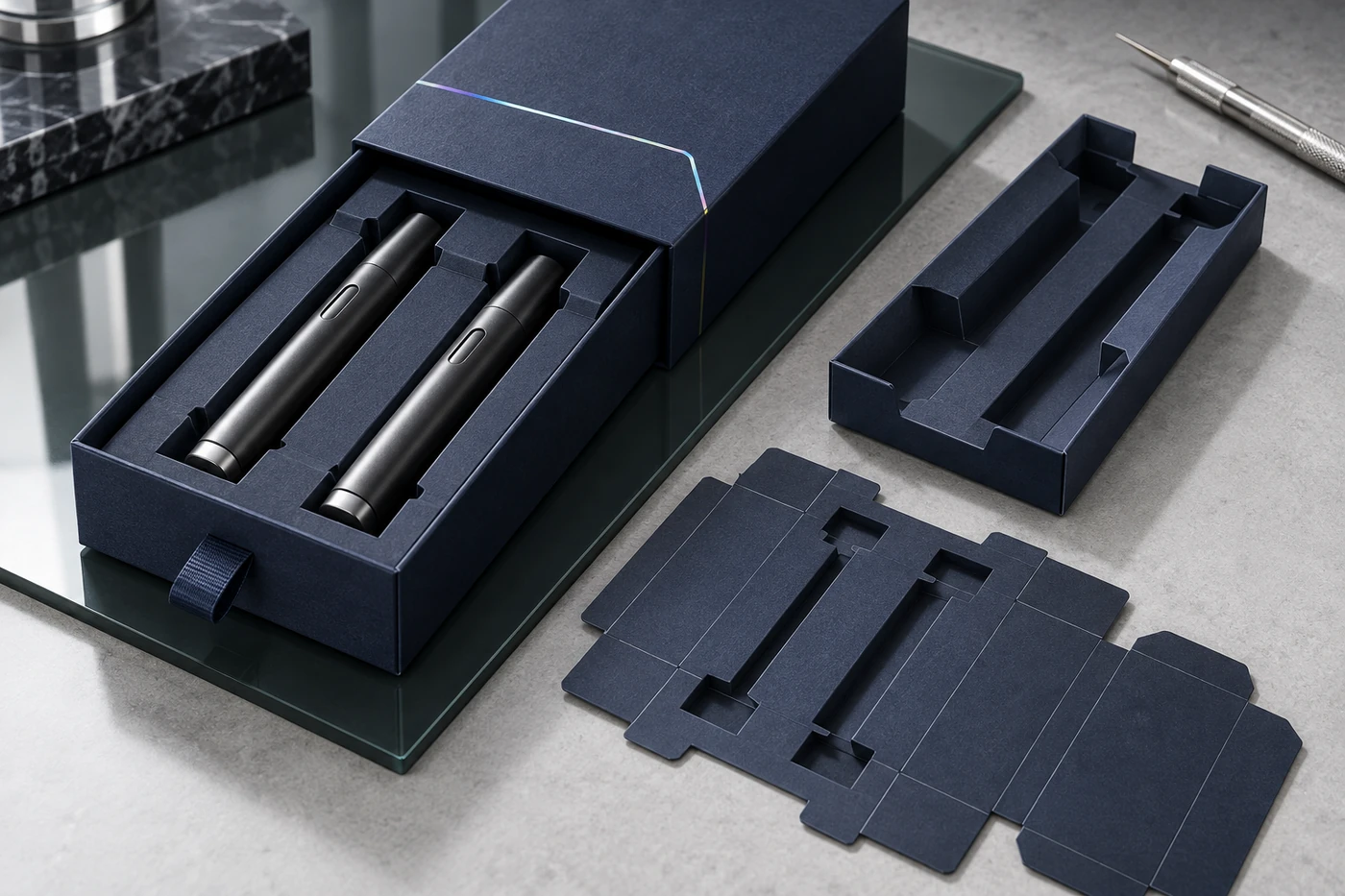
Ask for an assembled sample and an unassembled blank. The assembled piece shows fit and appearance; the blank reveals how many folds, locks and glue points the packing team must handle. Check whether a tab springs open, whether a narrow bridge buckles when the product is pressed into place, and whether the customer can reach the intended grip point without pulling the entire insert out.
For custom book-style gift boxes with magnetic closure, the insert must fit within the usable internal depth while leaving the lid and hinge free to close. A printed top card may create a clean reveal, but it should not hide a product that is difficult to remove or leave an unsupported heavy bottle over a large opening.
Use corrugated inserts for structure, not just because they look stronger
Corrugated box inserts can create deep cells, partitions and platforms with fewer layers than solid paperboard. They may be practical for a multi-piece kit, a heavier item, or an e-commerce presentation where exposed flute edges are acceptable. However, the flute direction, cutouts and bridges must match the load path. A tall divider that is strong in one direction may fold or crush differently when turned.
Appearance is another tradeoff. Natural kraft edges can support an honest material-led design, while a luxury presentation may need a paper wrap, printed top sheet or a different insert route. Those additions affect assembly and material separation, so compare the complete construction rather than calling every paper-based solution equivalent.
Use molded fiber when shaped pockets and tactile material matter
Molded fiber packaging inserts can combine several rounded cavities in one tray. This can be useful for sets of bottles, jars or accessories when a shaped surface supports the product at deliberate contact points. The material’s appearance may be a design feature rather than something that must be hidden.
Buyers should still review the actual sample surface, wall thickness, edge definition and product release. Very tight vertical walls can make removal awkward; shallow pockets may organize products without controlling them when the package tilts. Ask which tooling and production process the quotation assumes, and make sure the prototype represents the intended production route closely enough for the decision being made.
A coordinated range such as custom luxury paper boxes and removable-cap tubes illustrates why format matters: a rectangular gift box can accept a multi-cavity tray, while a tube usually needs a different platform, collar or end-support concept. Do not scale one insert drawing into another package shape without checking loading and removal.
Choose foam or thermoformed plastic for a defined reason
EVA foam inserts can provide a crisp dark or colored presentation and close-fitting cutouts. They are often considered when the product shape is stable and buyers want a substantial interior. Specify the sampled thickness, density, surface treatment, cavity depth and any laminated top layer. “Black foam” alone is not a usable purchasing specification.
A custom child-resistant pre-roll box with paper, EVA or foam insert options also requires a strict separation of claims. The insert may organize the contents, but it does not by itself demonstrate that the complete package has a child-resistant function or satisfies a market requirement. The closure, box, insert, contents and test configuration must be evaluated under the applicable approval route.
Thermoformed plastic can use thin, repeatable cavities and can expose more of the product. It may be suitable when visibility, wipe-clean surfaces or a particular retention shape matters. Ask for the polymer and gauge rather than accepting “plastic tray” as a description. Recovery options depend on the actual material, attached components and local collection system, so avoid blanket recyclable or sustainable claims.
Match the insert to the product and packing operation
Small cylindrical products expose different problems from jars or gift sets. For slide-out cartridge boxes with foam, blister or paperboard insert options, compare the retention shoulder, end clearance and the customer’s grip point. A cavity that looks precise can still be frustrating if the product sits below the fingertip opening or if a cap catches under the bridge.
In custom disposable-device packaging with drawer, magnetic and tuck-end formats, the box structure changes what the insert must do. A drawer needs clearance to travel through its sleeve; a magnetic book box needs lid clearance; a folding carton may rely on internal flaps rather than a separate thick tray. Approve the exact structure, not a generic insert shown in a different box.
Run a short packing trial. Record the time to erect or place the insert, the sequence for loading products, whether products rotate or pop out, and whether operators need an extra jig or adhesive. Inspect several samples, not only the best-looking one. The cheapest unit price can lose its advantage if packing is slow, components are easily reversed, or the assembled pack needs a larger shipping carton.
Compare quotations on the same scope
Ask each supplier to quote the same product configuration, order quantity, material thickness or density, print and finish, tooling, assembly state, packing method and sample route. State whether inserts arrive flat, pre-assembled, glued into the box or packed separately. Include the outer shipping carton and any void fill if it is part of the supplier’s responsibility.
Then separate one-time items from recurring unit costs. Tooling, cutting forms, molds, setup and sample work may not behave the same way at repeat order. Do not infer a saving from an omitted component. A low insert price is not comparable with a quotation that includes assembly, top cards, adhesive application or a more complete test sample.
Approve the assembled configuration, then validate the route
Approve the insert with the actual finished product or a dimensionally and physically representative substitute agreed for the test. Check orientation, contact points, surface marking, movement when the box is tilted, finger access, closure clearance and appearance after repeated removal. Confirm the revision of the box, insert and product together.
Where distribution protection is required, use an appropriate test plan for the intended route. A published carrier package-testing procedure hosted by ISTA illustrates why a complete test sample matters: evaluation can include drop, impact, compression and vibration in sequence, followed by inspection of the contents. This is an example of test scope, not a claim that it applies to every shipment. A screen rendering, empty box or attractive retail photograph cannot establish that performance.

Packaging insert sample approval checklist
- Record each product’s finished dimensions, mass, fragile areas and approved orientation.
- Name the insert material, grade, thickness or density and production process.
- Mark every product contact point, retention shoulder and required clearance.
- Check loading sequence, assembly time, reversed-component risk and any adhesive or jig.
- Verify customer finger access and removal without product or surface damage.
- Test the box closure, hinge or drawer movement with the loaded insert.
- Confirm what the retail box, outer shipper and void fill are each expected to do.
- Approve a controlled revision using the intended packed configuration.
- Arrange distribution testing when protective performance is part of the requirement.
- Document material-separation and disposal instructions only for the actual construction and destination.
Frequently asked questions
Is paperboard always the lowest-cost insert?
No. Material area, cuts, folds, printing, assembly and reject risk all affect cost. Compare a complete assembled scope at the same quantity rather than comparing material names.
Does a tight insert mean the product is protected?
Not necessarily. A tight cavity can concentrate force, mark a surface or make removal difficult. Protection depends on the complete package, contact points, distribution hazards and validation method.
Can one insert fit several product sizes?
Sometimes, if adjustable tabs, collars or separate components are deliberately designed and the resulting fit is checked for every product. Do not approve a “universal” cavity from nominal dimensions alone.
Which insert is most sustainable?
There is no responsible universal answer. Use the least complex construction that performs the required job, then evaluate material source, manufacturing, mass, reuse, separation and the actual recovery system in the destination market. Avoid claims based only on appearance.
Request a quotation with the insert brief attached
Send PaperBoxPro your product dimensions, mass, photos or drawings, box style, quantity, packing method and insert responsibilities. Ask for comparable material routes and specify what the physical sample must prove. A useful quotation should make the construction, assembly scope and approval limits visible—not hide them behind a single material label.
Editorial context: AI-assisted drafting and separate model self-review using the linked official carrier guidance and authenticated PaperBoxPro product pages. Images are AI-generated design concepts, not engineering dielines, laboratory records, approved customer orders or compliance evidence. No human or laboratory review is claimed.