
Use a printed belly band when a stable chocolate box can carry the permanent product identity and a removable paper component can carry the seasonal message. Choose a fully printed seasonal box when the campaign needs an uninterrupted design, the band would obscure essential panels, or fitting a second component creates more work than the flexibility is worth. Approve the assembled pack, including its appearance after the band is removed, before comparing final quotations.
For chocolate brands, boutique retailers and corporate gift suppliers, this is a decision about two connected packaging components. A band can make a shared carton look seasonal, but it also introduces a fit specification, another artwork version and an application step. A dedicated festive carton concentrates the design in one component while tying that carton stock to the campaign. The right choice depends on what changes, what must remain visible and who assembles the order.
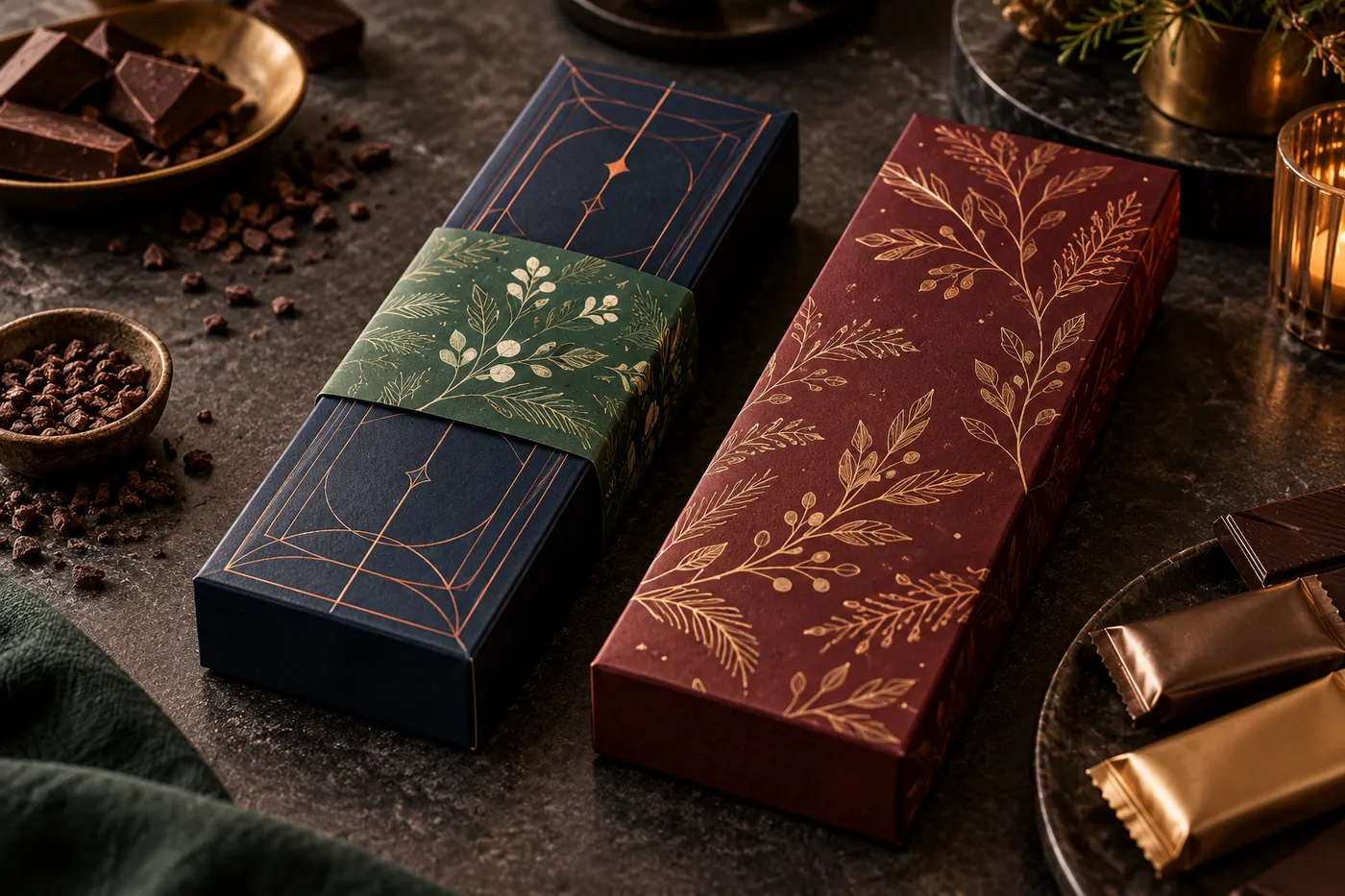
Separate the permanent box from the seasonal message
Start with a content map rather than a decorative mockup. List the brand name, chocolate variety, product information, identification codes and opening instructions that belong to the continuing product. Then list the campaign elements: a winter illustration, gift greeting, event identity or corporate presentation. Ask your responsible product team which information must remain with the pack throughout sale and use in the intended market.
A removable band should not become the only place where a buyer can identify the chocolate after the seasonal decoration is taken off. If the box underneath is completely generic, removing the band may leave an attractive but ambiguous pack. Conversely, repeating every panel on both components can create conflicting versions when one artwork changes.
The available chocolate window boxes with optional printed belly bands provide a relevant starting format: the box and band can be specified together, with band position checked against the viewing window and printed information. This is an outer packaging choice; it does not establish food-contact suitability or replace the appropriate inner wrapper.
Compare the complete packaging routes
| Route | Useful starting conditions | What the buyer must resolve |
|---|---|---|
| Continuing box plus seasonal belly band | The wrapped product and box dimensions stay stable; seasonal decoration changes | Band fit, component matching, application and the uncovered box appearance |
| Fully printed seasonal box | The campaign needs a complete visual treatment and has a defined sales window | Artwork commitment, quantity by design and remaining seasonal cartons |
| Continuing box plus full outer sleeve | More coverage is needed than a narrow band provides | Sleeve loading, covered panels, opening access and additional material |
A belly band wraps around part of a box and leaves other areas exposed. A full sleeve covers more of the package and may change how it is opened. Do not let a quotation use “sleeve” and “band” interchangeably without a drawing. State the finished coverage, seam location and removal method so both suppliers are pricing the same component.
For custom chocolate cartons for seasonal products and event favors, consider whether the same underlying design still looks intentional without the campaign layer. A restrained permanent carton may support several occasions. A carton already dominated by a specific holiday cannot gain that flexibility merely by adding another band.
Specify band fit around the assembled carton
Measure and sample the completed box with the actual wrapped bar inside. An empty carton may sit differently once its flaps are closed around a wrapper seam. Specify the direction in which the band travels around the box, its width along the box face and the location of the overlap or joint. A flat artwork width alone does not define the finished fit.
Ask the manufacturer to propose and document the clearance using the selected paper and finished carton. There is no universal allowance supplied by this guide. A band that is hard to slide into place may slow packing or mark the finish. A loose band may drift across a window, conceal information or slip off during ordinary handling. Assess both outcomes on physical samples.
Include the thickest normal wrapped-bar configuration in the trial, especially if wrapper folds or toppings change the pack profile. If several bar sizes share an illustration, do not assume they can share a band dimension. Give each approved box-and-band combination its own specification reference.

Choose how the band is fitted and removed
Agree whether bands arrive as closed loops, flat pieces to be joined during packing, or components already fitted to cartons. Ask which route is actually available for the order. These arrangements require different handling and should be priced separately. If the packer must form the band, define the joining method and inspect the finished seam.
Decide whether shoppers slide the band off, tear it or remove an attachment. Do not describe an ordinary decorative band as a security seal. Any tamper-evidence requirement needs its own design and validation. Keep the intended removal action clear without making the customer damage the main carton simply to reach the chocolate.
Keep the window, opening and information usable
Print the proposed band outline on a mockup and view it in the actual retail orientation. A centered design can look balanced in artwork while hiding the most useful part of a window. A motif placed across a tuck flap can also make a simple opening action awkward. Review the front, back, edges and base with the band in its allowed positions.
For festive chocolate packaging for boutiques and gift promotions, a fully printed seasonal design may be preferable when the complete front needs to communicate the occasion. Compare that result against a band mockup at normal viewing distance. The decision is about usable presentation, not a rule that one format always looks more premium.
Check the uncovered pack as carefully as the dressed pack. Confirm that essential information remains available in the required way for the target market, and that any barcode intended for checkout is accessible in the selling configuration. Have the responsible team approve this content map; decorative packaging advice is not a substitute for market-specific labelling review.

Quote the band system against the finished seasonal box
Request comparable quotations using the same wrapped-bar dimensions, sales quantity, destination and intended presentation. For the band route, separate the permanent carton, each band artwork, decorative processes, component delivery and fitting work. For the dedicated box, separate the seasonal artwork and finishes on the complete carton. Include sampling for the assembled combination.
For Christmas chocolate gift cartons with printed festive designs, ask which visible features genuinely require a separate process. A foil detail confined to a small band is a different quotation from foil across several carton panels. Neither is automatically cheaper without the actual quantities, paper specification and production setup.
Use a complete comparison: carton purchase plus seasonal components plus fitting and checking work, plus any packaging that cannot be used after the campaign. Divide by the saleable packs supported by that plan if you need a per-pack measure. Use your own supplier quotes and demand assumptions; there is no defensible universal saving percentage for adding a band.
Consider a planning example rather than a claimed customer result: one unchanged wrapped chocolate bar serves a winter promotion and a later corporate event. A shared carton may be useful if only the message changes. If the later order requires a different bar thickness or a different information panel, that common-carton assumption must be reconsidered before committing stock.
Approve the pair and control the packing instructions
A carton proof and a band proof viewed separately cannot show every interaction. Request an assembled sample with the agreed substrate and finish where fit or appearance depends on them. A structural mockup can establish placement, while the relevant printed sample is needed to judge the intended graphics and surface combination.
The printed chocolate cartons and sleeve-and-tray options for artisan ranges illustrate why structure comes first: a tuck carton and a sliding tray do not necessarily accept the same band position or opening sequence. Reference the actual chosen construction in the sample request rather than approving a decorative rendering alone.
Use an assembled-pack acceptance checklist
- Identify the approved carton version and its matching band version.
- Confirm band direction, width, joint position and permitted placement range.
- Fit the band to filled samples and check sliding, drift and visible surface marking.
- Review the viewing window, checkout code and required information in the sale configuration.
- Remove the band and inspect product identification, opening access and presentation underneath.
- Record the packing method and which business supplies and fits each component.
- Photograph the approved assembled pack and retain the agreed specification for repeat orders.
If a trial fails, change the relevant feature and repeat the assembled check. Widening a band, changing paper or moving a seam can affect more than its appearance. Record the revised version so the carton supplier, band supplier and packing team work from the same approval.

Frequently asked questions
Can a belly band make an ordinary box suitable for every holiday?
Only if the underlying design, product information and physical fit remain appropriate. A removable greeting does not correct an unsuitable box size or an outdated product panel. Review each campaign against the continuing specification.
Is a paper band always less expensive than printing a seasonal carton?
No. It adds a separate component and fitting work. Compare the whole plan, including artwork quantities, finishes, samples, assembly and unusable stock. A band can provide flexibility without producing the lowest finished-pack cost.
Can the same band fit different chocolate bar boxes?
Possibly, but common graphics do not establish common dimensions. Check the assembled perimeter, paper, clearance and placement for each box. Approve and identify each combination before sharing a component across products.
What should we send for a factory quotation?
Send the finished wrapped-bar dimensions, box construction, quantities by campaign, permanent and seasonal content maps, desired band coverage, finishes, packing responsibilities and destination. Include the required arrival date so sampling, production and transport can be considered separately.
Build the seasonal pack with the factory
NEXA Packaging is a manufacturing factory producing custom paper boxes and custom paper tubes. Factory-direct pricing reduces trading intermediaries and their markups, while direct communication with production helps coordinate costs, scheduling and quality follow-up. The factory takes direct responsibility for its production quality and related follow-up; agree the order-specific requirements before approval.
Typical production lead time is 7–15 working days, excluding shipping, subject to quantity, structure, finishing, materials and the final confirmed schedule. Send your box-and-band brief or fully printed seasonal-box concept for a comparable factory quotation. Request the relevant samples before releasing the complete packaging order.
Editorial context: this guide was prepared with AI assistance and model self-review. Images are original AI-generated packaging concepts, not customer projects, production photographs or engineering approvals. Product-page examples establish available packaging formats; the checks above are purchasing recommendations to confirm for your order.