
You send the same box photograph to three suppliers and receive three very different prices. Is one factory expensive, is another cutting corners, or are you actually comparing three different packaging specifications?
Custom packaging quotes often differ because the suppliers are pricing different materials, construction, decoration, quantities, or delivery scopes—even when the boxes look similar. Before negotiating the unit price, put every quotation against the same written brief and compare the total cost of getting usable packaging to your packing operation.
This guide gives purchasing teams a practical way to compare custom packaging quotes, identify missing charges, and request useful cost-saving alternatives. It focuses on empty paper packaging, not the products packed inside it.
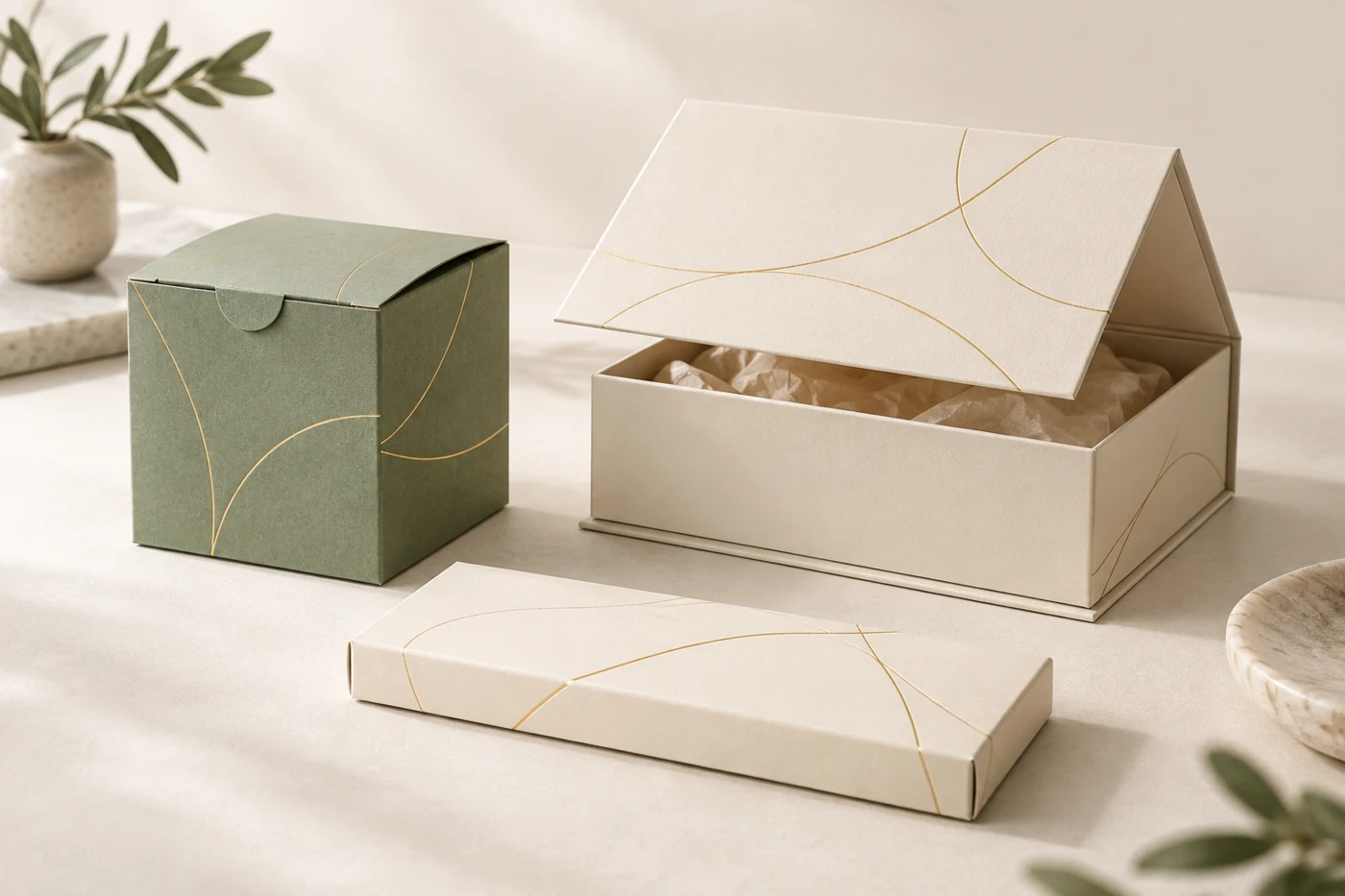
Start with a specification, not just a photograph
A reference image communicates style, but it rarely establishes board grade, wall thickness, internal dimensions, or assembly. Two quotations based only on an image may both be reasonable while describing different products.
Create a baseline specification before asking suppliers to revise their prices. Include the box structure, internal dimensions, product weight, material, printing, finishes, insert, order quantity, and delivery destination. Identify which details are fixed and which the supplier may propose changing.
For example, when requesting custom chocolate candy bar packaging, provide the dimensions of the wrapped bar rather than only its weight. State whether the quotation is for an outer carton alone or also includes an inner wrapper. Those are separate components, and they should not disappear inside the phrase “complete packaging.”
For food projects, describe whether any component touches the food and request documentation appropriate to that intended use. A decorative outer box should not be assumed to replace the protective function of an inner pack.
1. Are the structure and materials genuinely equivalent?
“Cardboard box” is not a sufficiently detailed purchasing specification. A printed folding carton and a paper-wrapped rigid box involve different components and assembly steps. Even within one structure, different board grades or covering papers may produce different results.
Ask each supplier to identify the proposed material instead of relying on adjectives such as premium, thick, or luxury. Where relevant, record grammage, thickness, surface treatment, and the covering material. Do not assume equal grammage guarantees equal stiffness or identical appearance; evaluate the proposed sample against your actual requirements.
When comparing custom book-style gift boxes, separate the board, outer wrap, closure, and insert in the brief. Ask whether the box arrives assembled. A quotation for a rigid magnetic gift box is not directly comparable with one for a folding carton that merely imitates its appearance.
Then identify the performance you need. If a lower-cost material meets the required fit, appearance, and handling conditions, it may be a sensible option. Request it as an alternative specification, not as an undocumented substitution to the approved version.
2. Which inserts and accessories are included?
A low price may cover only the outer box. Inserts, dividers, ribbon pulls, liners, sleeves, and labels can be separate items. Assembly or placement of those components may also be excluded.
For custom hemp oil bottle packaging boxes, describe the actual bottle and closure dimensions and ask whether internal support is included. Do not assume every listed packaging option includes the same insert or protective performance. Review the proposed structure with a representative bottle before accepting the specification.

Make the accessory question concrete: “Does this price include the outer carton, fitted paper insert, and insertion of that component into each box?” If the answer is no, request the additional price and decide who will perform the work.
The same discipline helps with custom flip-top cigarette packaging boxes: confirm whether optional inner liners and tear tape are included or excluded. Here, the comparison concerns empty packaging components only; a box quotation does not establish regulatory suitability for its eventual contents.
3. Are printing and finishing priced the same way?
“Printed logo” can describe several different production choices. Confirm the number of printed sides, process or spot colors, coverage, and finish. A printed gold-colored graphic is not the same specification as metallic foil stamping.
Ask the supplier to list decoration operations rather than combining them into one vague description. If the quotation includes foil, embossing, or spot varnish, identify the artwork area and location. This makes it easier to request a simpler option without changing the rest of the box.

For a seasonal project such as custom Christmas chocolate bar packaging, request a baseline printed carton and a separately priced decorative upgrade. You can then decide whether the additional treatment is worthwhile for the campaign instead of assuming every premium effect is essential.
Do not apply a universal saving percentage to removing a finish. The effect depends on the job, quantity, and production method. Ask for a revised quotation based on your actual artwork and keep the alternative clearly labeled.
4. Does the quantity apply to one design or several?
A request for 5,000 boxes may mean one design, five designs of 1,000, or ten designs of 500. Those orders are not automatically equivalent. Clarify quantities per size, artwork version, and finish combination.
Ask which preparation costs are fixed for the job and which charges change with quantity. Depending on the process, these may include cutting tools, printing preparation, or finishing tools. Some suppliers itemize them, while others include them in the unit price. A blank setup-charge line does not prove that no preparation cost exists.
Request comparable quantity breaks using an unchanged specification. Then ask whether the quotation assumes shared production across versions and whether changing artwork or dimensions would require new preparation.
As a supplier-specific example, Refine Packaging’s published pricing FAQ describes quantity, dimensions, material, style, and printing or coating as price factors, and notes that two-sided printing may add cost. Treat this as evidence of the variables to clarify—not a price benchmark or a promise about another factory’s quotation.
5. Is delivery to the same place included?
A factory collection price and a delivered price should not sit in the same comparison column without adjustment. Ask what transport, handling, and destination charges are included, what remains excluded, and how long the shipping estimate is valid.
Request the proposed packing details: units per shipping carton, carton dimensions, gross weight, and number of cartons. Flat-packed cartons and assembled rigid boxes can occupy very different volumes. Compare the packed shipment, not merely the weight of one empty retail box.
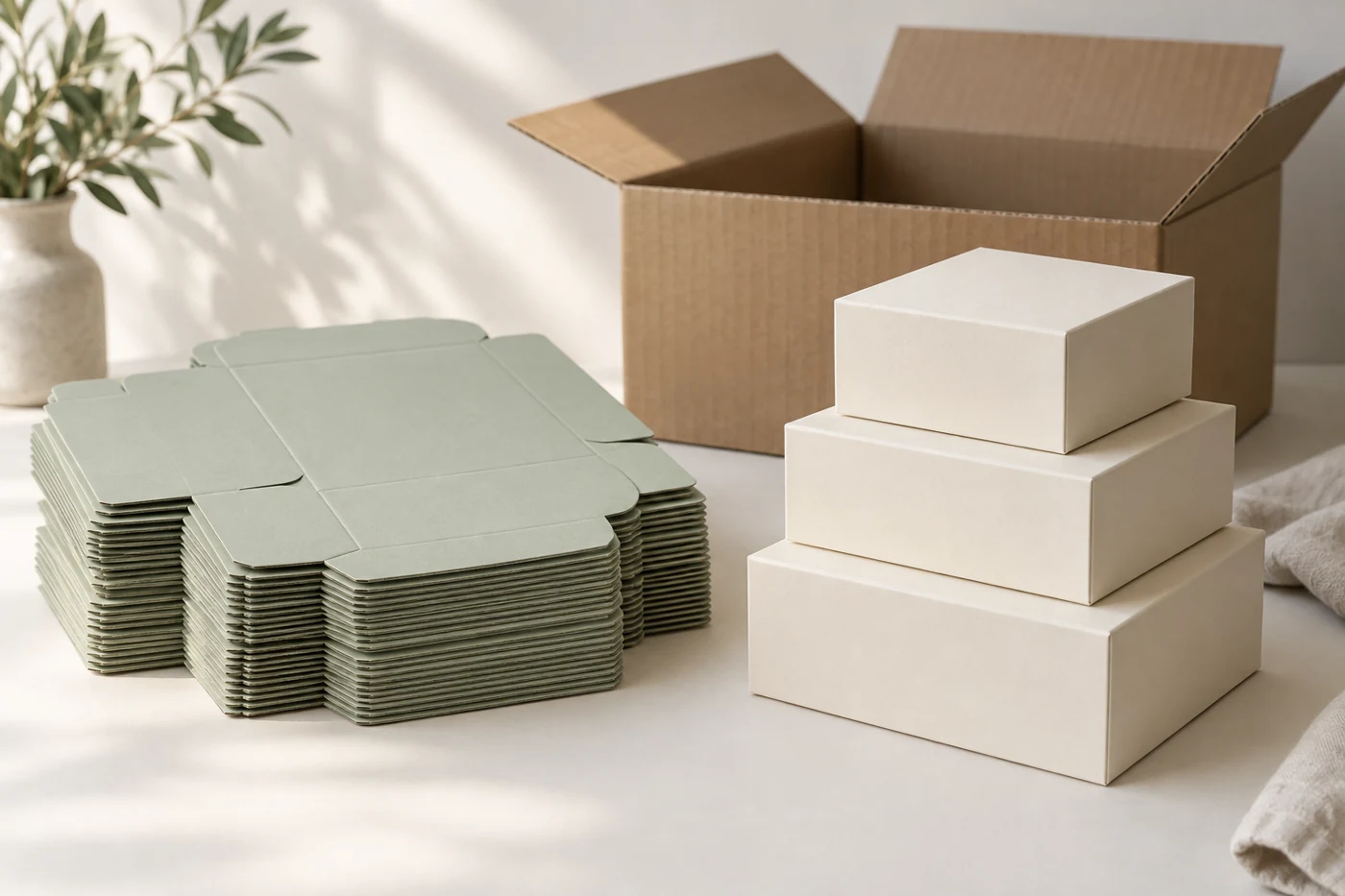
FedEx explains dimensional weight as a measure of package space relative to actual weight, with its shipment charge based on the greater of the two. Your service and contract determine the applicable rules, so use the carrier’s current quotation rather than applying one formula to every shipping method.
Include your receiving operation in the decision. A compact flat shipment may be attractive, but somebody still has to assemble and fill the boxes. Ask your packing team to trial the proposed format before assuming lower freight automatically means lower overall cost.
A quote-comparison table you can actually use
Copy the following fields into your purchasing worksheet. Ask every supplier to respond to the same version, and mark missing information as “not confirmed” rather than guessing.
| Comparison field | What to record | Why it matters |
|---|---|---|
| Structure and dimensions | Box style, internal size, approved drawing revision | Prevents comparison of different constructions |
| Material and decoration | Named material, printed sides, colors, finishes | Makes appearance and material alternatives visible |
| Components and assembly | Insert, liner, ribbon, assembly responsibility | Exposes items outside the outer-box price |
| Quantity and preparation | Units per design, setup charges, repeat-order assumptions | Separates volume effects from specification changes |
| Delivery and acceptance | Packing details, destination, exclusions, agreed inspection | Supports a comparable total-cost decision |
A worked example: the lower unit price is not always the lower total
The following figures are hypothetical arithmetic examples, not PaperBoxPro prices or current market quotations. Assume both offers otherwise meet the same specification and delivery scope.
- Offer A: 1,000 boxes at $0.80 each, plus $150 preparation and $250 shipping. Total: $1,200.
- Offer B: 1,000 boxes at $0.95 each, preparation included, plus $180 shipping. Total: $1,130.
Offer B has a higher displayed unit price but a total that is $70 lower. The delivered cost per ordered box is $1.20 for A and $1.13 for B. Check that a charge described as included has not also been added elsewhere.
Now consider a hypothetical larger order: 2,000 boxes at $0.60, plus $150 preparation and $350 shipping, totals $1,700. The average is $0.85 per ordered box, but the cash outlay is higher. If you need only 1,000 before an artwork change, the lower average may not justify the extra inventory.
Use realistic demand, storage capacity, and revision risk when choosing the order quantity. Do not invent a defect allowance simply to make one offer win; record quality requirements and evaluate evidence separately.
How to ask for savings without inviting hidden compromises
Ask for two clearly defined alternatives to the baseline. One might simplify decoration; another might adjust the structure or packing arrangement. Require the supplier to explain exactly what changes and what stays the same.
Protect the features your product genuinely needs: fit, closure, handling performance, and required information. Evaluate alternatives with a sample or packing trial as appropriate. Removing a component that prevents movement can be false economy if the resulting package no longer does its job.
Finally, confirm the accepted quotation revision in writing. Record the sample basis, quantity, delivery scope, and approval steps. Keep later changes visible so the production team is not working from a specification that differs from the one you priced.
Frequently asked questions
Can I compare quotations using the same box dimensions?
Dimensions help, but they are not enough. Match structure, materials, printing, accessories, quantity per design, and delivery scope as well. Confirm whether the dimensions are internal or external before treating two boxes as equivalent.
Does a higher order quantity always make the purchase cheaper?
It may reduce the unit price, but it can increase total spending and storage needs. Compare the amount you expect to use before the design changes, not just the price of each ordered box.
Will setup charges disappear on my next order?
Not necessarily. Ask which tools or preparation can be reused and under what conditions. Changes to dimensions, artwork, materials, or finishes may change the repeat-order price. Get a new quotation rather than assuming the first order defines every reorder.
What should I send for a useful custom packaging quote?
Provide product dimensions, box style, artwork, material preference, required finishes, quantity per design, and delivery destination. Include photographs as visual references, but clearly describe what is required and what may be proposed as an alternative.
Get a quotation you can compare with confidence
A useful quotation makes assumptions visible. When every supplier prices the same specification and scope, you can discuss genuine trade-offs instead of negotiating numbers that describe different boxes.
Request a custom packaging quotation from PaperBoxPro with your dimensions, quantity per design, artwork, and delivery destination. Ask for a baseline specification and clearly itemized alternatives so you can choose the option that fits both your product and your budget.
Images are AI-generated packaging concepts, not photographs of customer orders or measured shipping-capacity comparisons. Numerical examples are illustrative only.