
A strong smell from newly produced custom printed boxes usually comes from the combined ink, coating, adhesive, paperboard, curing, and packing process—not from one material alone. The practical fix is to identify when the odor appears, compare a finished box with its individual components, and agree on a production-representative sensory check before the full order ships. Simply leaving every box open for an arbitrary number of days may reduce some volatile compounds, but it does not diagnose the cause or prove that the packaging is suitable for a sensitive product.
This distinction matters for chocolate, edible products, cosmetics, supplements, CBD oils, and other goods whose aroma is part of the customer experience. A buyer approving custom chocolate bar packaging, for example, should treat odor as a defined acceptance characteristic rather than a vague last-minute complaint.
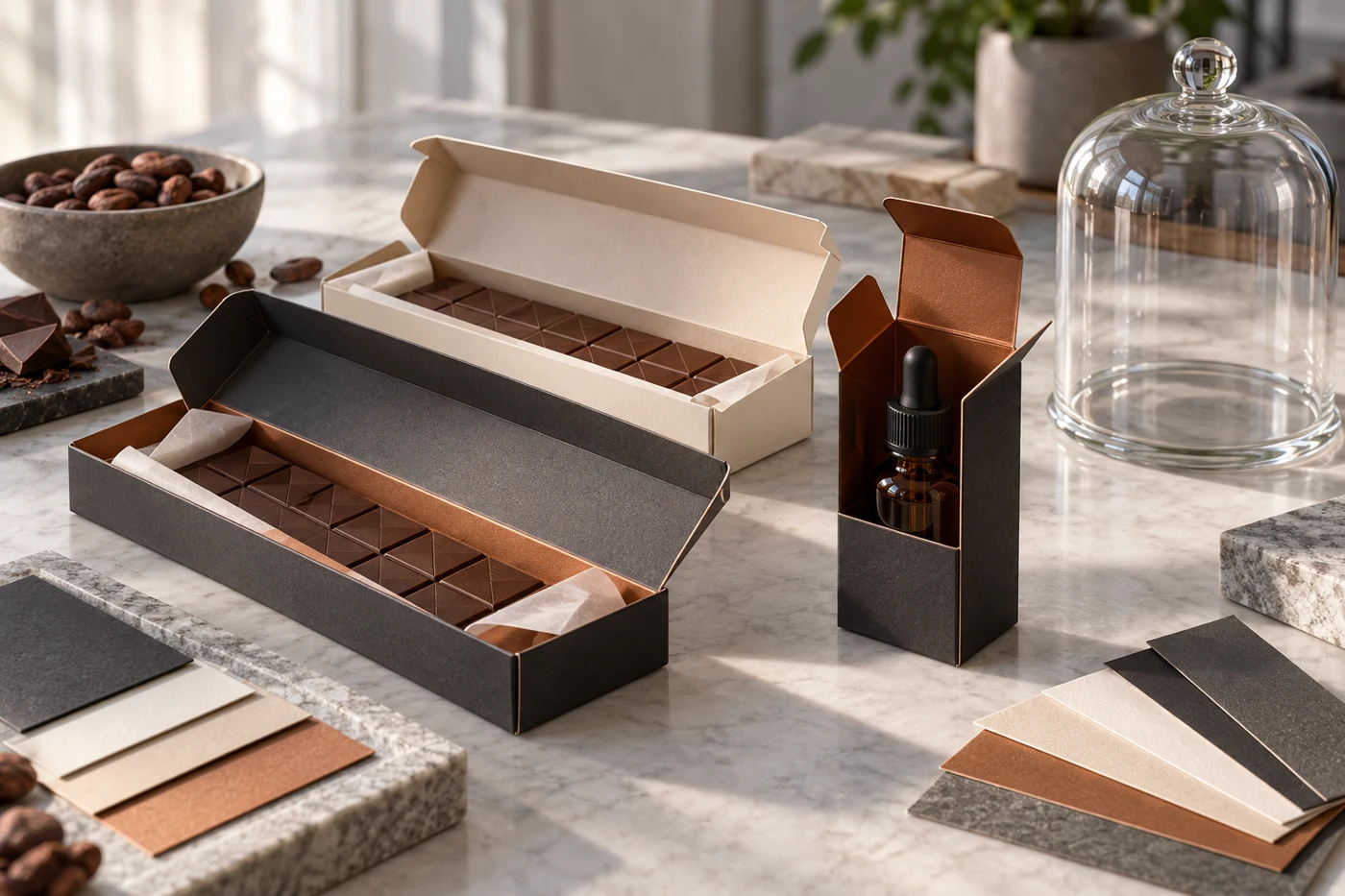
First, separate odor, off-flavor, migration, and compliance
These terms are related, but they are not interchangeable. Odor is what a person detects from the package or its headspace. Off-flavor is an unwanted sensory effect perceived in the product. Migration is the transfer of substances from packaging components into food or another packed product under defined conditions. Compliance depends on the intended use, materials, construction, applicable market, and supporting documentation.
A box can have a noticeable smell without contaminating the product. Conversely, a package that seems odorless is not automatically migration-compliant. The European Printing Ink Association explains that inks on the non-food-contact surface of food packaging still require suitable formulation, manufacturing controls, and information exchange through the supply chain. Its principles for food-contact materials support a risk-based approach rather than a simple sniff test.
The print side also changes the decision. An ink intended for the outside of a carton is not automatically suitable for direct food contact. The European Commission’s food-contact-material overview explains that packaging components can affect safety as well as taste and smell, and that intended contact conditions matter. If a structural panel, insert, or printed interior can touch an unwrapped product, state that condition before the printer selects the ink and coating system.
Where does the smell in a printed carton come from?
1. Ink drying and oxidation
Conventional offset inks may dry partly through oxidation. The chemistry and drying conditions can create volatile by-products with a noticeable odor, particularly when cartons are stacked or packed before the process is complete. This does not mean that all offset printing is unsuitable for sensitive products; it means that the ink series, board, coverage, drying time, and end use need to be specified together.
Some packaging ink systems are formulated specifically to reduce sensory impact. For example, hubergroup describes its MGA CONTACT system as one that does not dry by oxidation, which is intended to avoid certain sensory-noticeable aldehydes. That is a supplier-specific system with defined applications, not a universal promise for every printed box.
2. Incomplete or unsuitable UV curing
UV and LED-UV inks and coatings are designed to cure under a matched combination of chemistry, lamp output, exposure, press speed, film weight, and substrate. If the energy reaching the printed film is insufficient, residual components can remain and produce odor or surface problems. Heavy ink coverage, opaque whites, dense coatings, aging lamps, or an incompatible system can change the cure window.
A premium finish therefore needs process evidence, not just a glossy appearance. This is especially relevant when a festive chocolate gift carton with foil and UV effects uses several decorative layers. The buyer should ask whether the sample and production order will use the same substrate, ink family, coating, lamp technology, and press conditions.
3. Coatings, laminating films, and adhesives
Water-based or UV coatings, film lamination, window patches, foil transfer systems, and folding-carton adhesives can each contribute odor. Interactions matter: an acceptable board and acceptable adhesive may still behave differently when a barrier film slows the release of volatile compounds. A rigid insert, foam component, or sealed inner tray can add another source.
Highly decorated luxury holiday chocolate gift boxes often combine more processes than a simple reverse-tuck carton. List every component in the bill of materials and approve the complete construction, not only the printed outer wrap.
4. Paperboard, recycled fiber, storage, and transport
Paperboard can absorb odors from its storage environment, adjacent materials, cleaning products, fuel, smoke, damp areas, or transport. Recycled fiber is not inherently unsuitable, but its sourcing, barrier needs, and intended product contact should be considered. High humidity may also change how a carton smells and how quickly volatile compounds dissipate.
When an odor appears only after overseas transit or warehouse storage, compare retained production samples with received cartons. That comparison helps separate a manufacturing issue from contamination or confinement later in the supply chain.
5. Packing before the converted box has stabilized
Freshly printed, coated, laminated, or glued boxes may be bundled and enclosed while volatile compounds are still being released. A sealed polybag, master carton, or container concentrates the headspace odor. The right waiting period cannot be copied from another project: it depends on the process, film weight, air exchange, temperature, humidity, stack density, and product sensitivity.
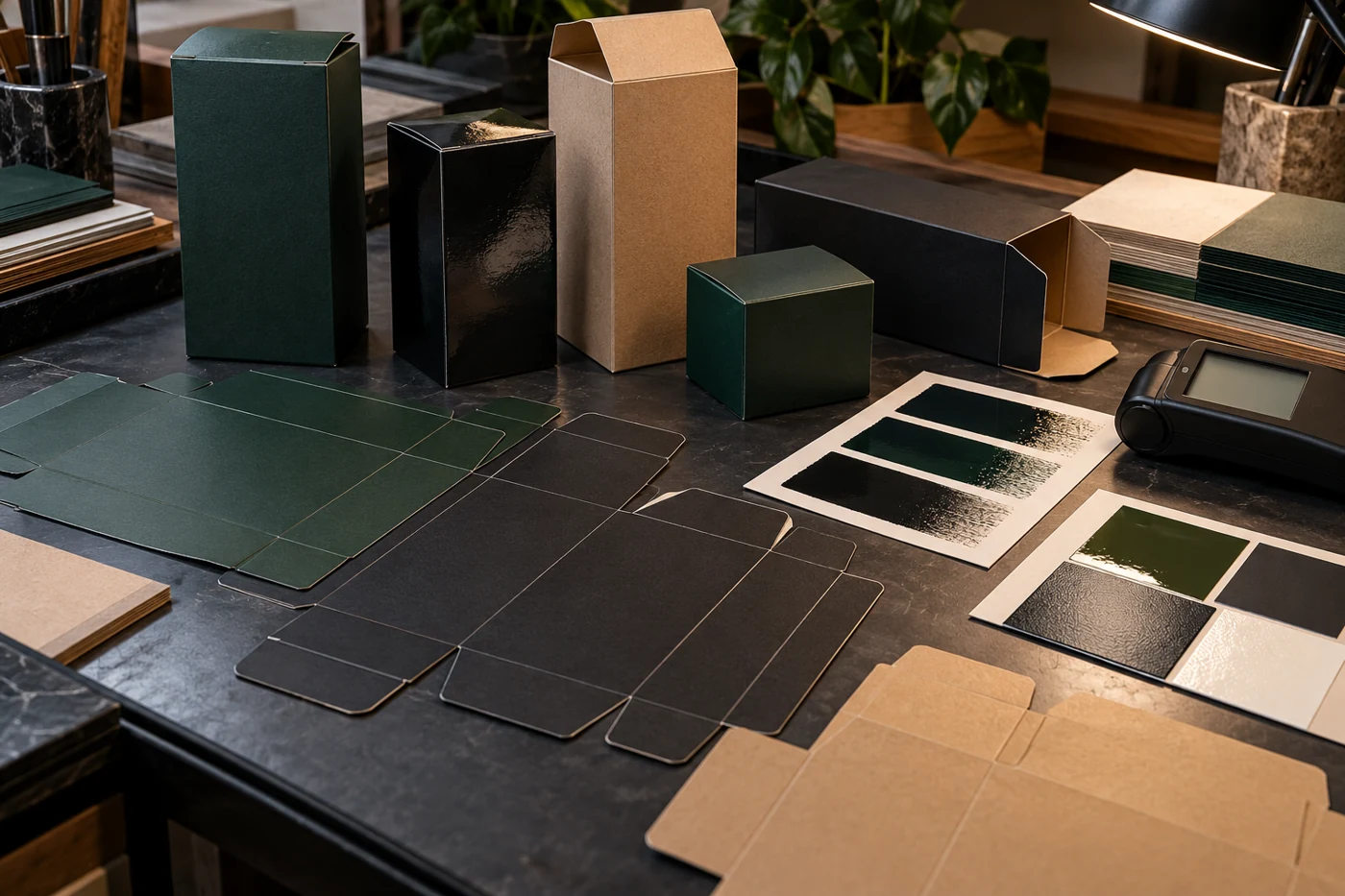
Use the odor pattern to narrow the likely cause
| Observed pattern | Likely area to investigate | Useful evidence | Buyer action |
|---|---|---|---|
| Strongest on dense printed areas | Ink or overprint coating | Printed versus unprinted board; ink and coating batch data | Confirm ink system, cure or drying conditions, and coverage |
| Strongest at seams or inserts | Adhesive, foam, or insert material | Unglued blank; separate insert; adhesive technical data | Test components separately, then test the assembled box |
| Appears after bagging or container transit | Early packing or environmental absorption | Retained open sample versus sealed shipped sample | Define conditioning and packing intervals; audit storage |
| Only the packed product changes aroma | Product-package interaction | Product control, filled-pack test, migration or sensory assessment | Escalate to qualified food-contact or product-safety evaluation |
| Varies between production lots | Raw-material or process variation | Lot records, press settings, cure checks, conversion dates | Require change control and lot traceability |
This component-by-component method is more informative than asking whether a box “smells normal.” It is also useful for high-coverage specialty chocolate cartons, where dark inks, tactile coatings, foil, or lamination may make the converted structure quite different from an undecorated paperboard sample.
What should buyers put in the RFQ?
Odor disputes often begin with an incomplete specification. Add the following information before quoting and sampling:
- Packed product and sensitivity: food, chocolate, tea, cosmetics, oil, supplements, electronics, or another category; wrapped or unwrapped.
- Contact map: which surfaces can touch the product, primary container, cap, sachet, or liner.
- Markets and intended use: destination countries, storage period, expected temperature, and whether the package is primary, secondary, or tertiary.
- Complete construction: paperboard, ink, coating, lamination, foil, window, adhesive, insert, and any inner bag.
- Sensory requirement: how the sample will be conditioned, contained, opened, compared, and accepted.
- Production equivalence: whether digital, offset, or press proofs use the same materials and finishing route as mass production.
- Change control: supplier notification before substituting board, ink, coating, adhesive, or another component.
For custom CBD and cartridge cartons, describe whether the package holds a sealed cartridge, an oil container, an edible product, or another format. The risk assessment and sensory priority are not the same. Likewise, luxury CBD packaging for tinctures or edibles may include inserts and finishes whose interaction needs evaluation as a complete pack.
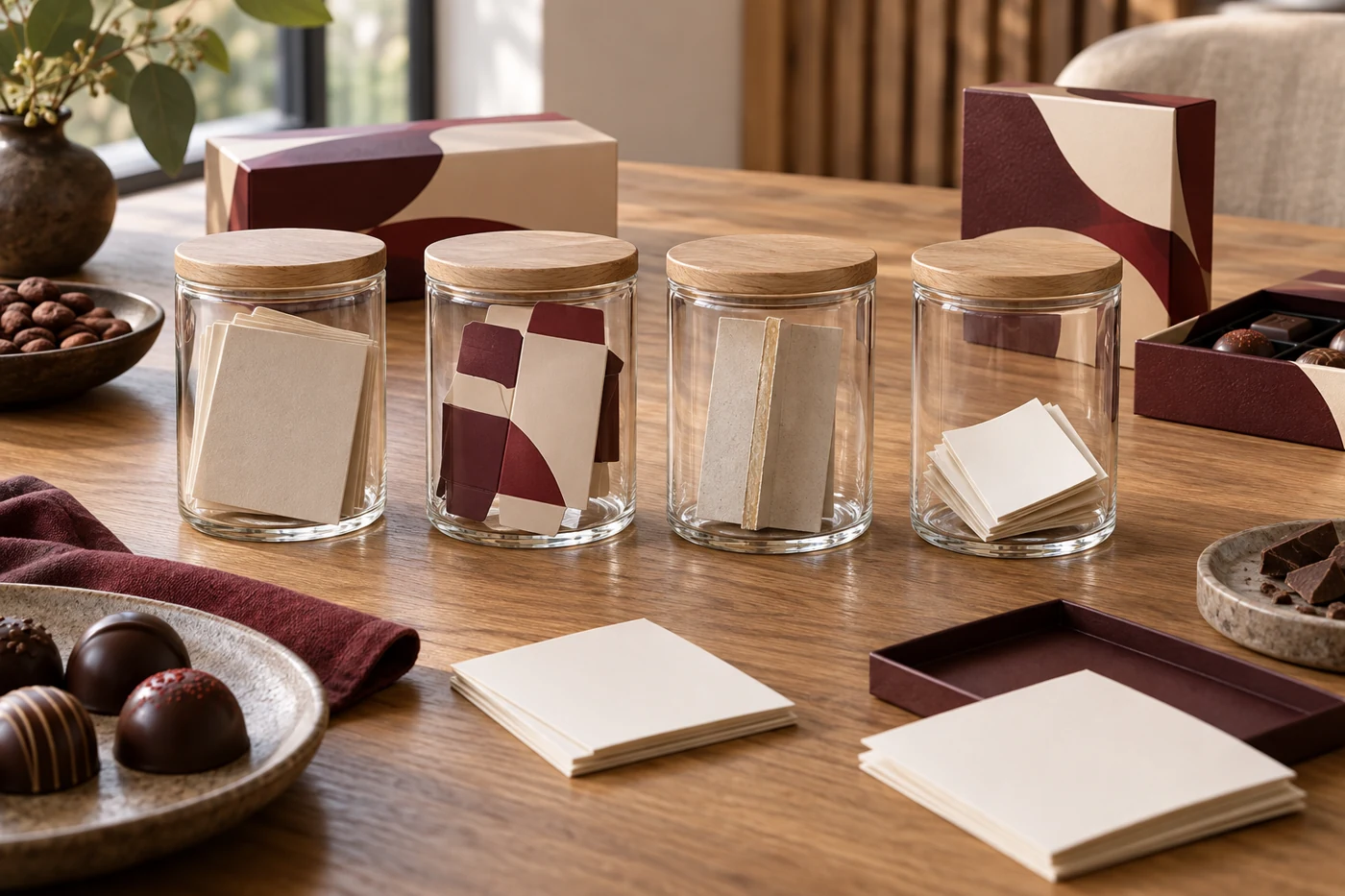
How to approve a production-representative odor sample
Start with a finished sample made from the proposed board, ink, coating, adhesive, and insert. Record the production date and the interval before evaluation. If the commercial press or finishing line differs from the prototype route, state that limitation and request a production trial where the risk justifies it.
Use a neutral control and a consistent closed-container method so evaluators are not simply smelling the room. Compare the complete box, an unprinted board sample, a printed but unglued blank, and separate inserts where practical. Evaluation conditions should be agreed in writing: sample size, conditioning time, container, temperature, number of assessors, rating scale, and acceptance decision. Do not invent a “pass” threshold after the order arrives.
For food-sensitive applications, sensory review should sit alongside—not replace—appropriate risk assessment, declarations, supporting supplier information, and migration testing when required. Siegwerk’s description of a low-migration and low-odor UV offset series highlights both set-off and storage considerations. The US FDA also notes several potential transfer routes—including penetration, set-off, and gas-phase transfer—in its research summary on photoinitiators used in exterior food-packaging inks. These examples show why a named, application-specific system is more useful than a generic request for “food-grade ink.”
What to do if production boxes fail the odor check
- Hold the affected lot. Do not mix it with approved inventory or pack sensitive products until the cause is assessed.
- Preserve evidence. Keep sealed and ventilated samples, outer packaging, lot labels, dates, and photos of storage conditions.
- Compare components. Separate board, inked areas, coatings, seams, inserts, and transit packaging where possible.
- Review process records. Check raw-material lots, press speed, lamp or dryer status, coating weight, gluing time, and packing time.
- Repeat the agreed test. Use the same conditioning and evaluation method as approval; avoid changing the protocol to obtain a pass.
- Correct and requalify. A material substitution, extra curing step, longer controlled conditioning period, or storage correction may help, but the revised complete pack should be approved again.

Questions buyers often ask
Does a strong smell always mean the box is unsafe?
No. Odor is a useful quality signal, but it is not a toxicology or migration result. Investigate the source and use the appropriate product-contact and regulatory assessment for the intended application.
Does “low odor” mean an ink can touch food directly?
No. Low odor describes a sensory property under specified conditions. Direct-food-contact suitability is a separate, application-specific determination involving the complete formulation, construction, and intended use.
Will airing the boxes solve the problem?
Ventilation may reduce some headspace odor, but it can also hide a process problem without resolving it. Identify the source first, document conditioning conditions, and confirm that the finished pack still meets the agreed specification.
Is a digital sample enough to approve odor?
Only if its materials and processes represent production. A digital proof can be useful for color and structure, but a different ink, coating, adhesive, or curing route may make it unsuitable for sensory approval.
What information should a supplier provide?
Ask for the proposed material and process specification, intended-use limitations, supplier documentation relevant to the application, change-control procedure, and a production-representative sample. The exact documentation depends on the product and destination market.
Approve the whole packaging system, not a single swatch
Printed box odor is most manageable when it is specified early and evaluated systematically. Define the packed product and contact surfaces, approve the complete bill of materials, test a production-representative construction, and keep lot and process records. That approach protects sensory quality without making unsupported claims about safety or compliance.
If you are preparing a packaging brief for an odor-sensitive product, contact PaperBoxPro with the box style, product format, finishing plan, destination market, and expected storage conditions. The team can use those details to discuss a more appropriate sample and material route before mass production.
Editorial note: This article provides packaging procurement guidance, not a product-safety or legal determination. The scene images are conceptual packaging-quality illustrations and do not depict a specific customer, certified laboratory, or production result.