
A box can feel flimsy even when the ordered paper grammage is correct because gsm measures mass per area—not thickness, bending stiffness, fibre direction, panel geometry, or the support created by the closure and insert. To control the result, packaging buyers should specify a named board or measurable performance profile, approve a production-intent structural sample, and evaluate the packed box rather than relying on “350 gsm” alone.
This distinction matters when two quotations use the same gsm but produce cartons with very different hand feel. One supplier may select a bulky folding boxboard with useful stiffness; another may use a denser sheet that meets the same grammage but is thinner. A wide panel may bow even with good board, while a smaller carton in the same material feels firm. The right decision comes from matching material properties to the box structure and product—not automatically adding more paper.

What does GSM tell you—and what does it leave out?
GSM is shorthand for grams per square metre. ISO 536:2019 specifies a method for determining the grammage of paper and board. That makes grammage a useful purchasing control: it helps identify whether the supplied material has the expected mass per unit area. It does not, however, define the sheet’s thickness or resistance to bending.
Thickness is measured separately. ISO 534:2011 covers single-sheet and bulking thickness and the calculation of apparent density and specific volume. Holmen Iggesund’s overview of defined paperboard physical properties likewise treats grammage, thickness and density as distinct measurements. If two sheets have the same grammage but different thickness, they have different apparent density. That is one reason two “350 gsm” boards can feel unlike each other.
For a buyer, the practical hierarchy is:
- Grammage controls mass per area.
- Caliper or thickness describes the sheet dimension through its cross-section.
- Bending stiffness describes resistance to bending under a defined test method and direction.
- Box performance adds panel size, grain orientation, creases, closures, inserts, product weight, assembly, and handling.
Do not use those terms interchangeably in an RFQ. If tactile firmness is important, ask the converter which board grade, nominal caliper, and stiffness data support the proposed gsm.
Why can the same GSM produce a different box feel?
Board construction changes bulk and stiffness
Paperboard is engineered in different grades and ply structures. Fibre selection, middle-ply construction, refining, pressing, coating, and calendering affect density, surface, thickness, and mechanical behavior. Holmen Iggesund’s paperboard stiffness guidance describes stiffness as a key specification after grammage and thickness. It also explains that stiffness is direction-dependent.
A low-density board can provide greater thickness at a given grammage, but “bulkier” is not automatically better for every job. The outer plies must still support printing, die-cutting, creasing, gluing, and surface durability. A dense board may offer other strengths. The comparison must use the finished carton requirements, not a single property in isolation.
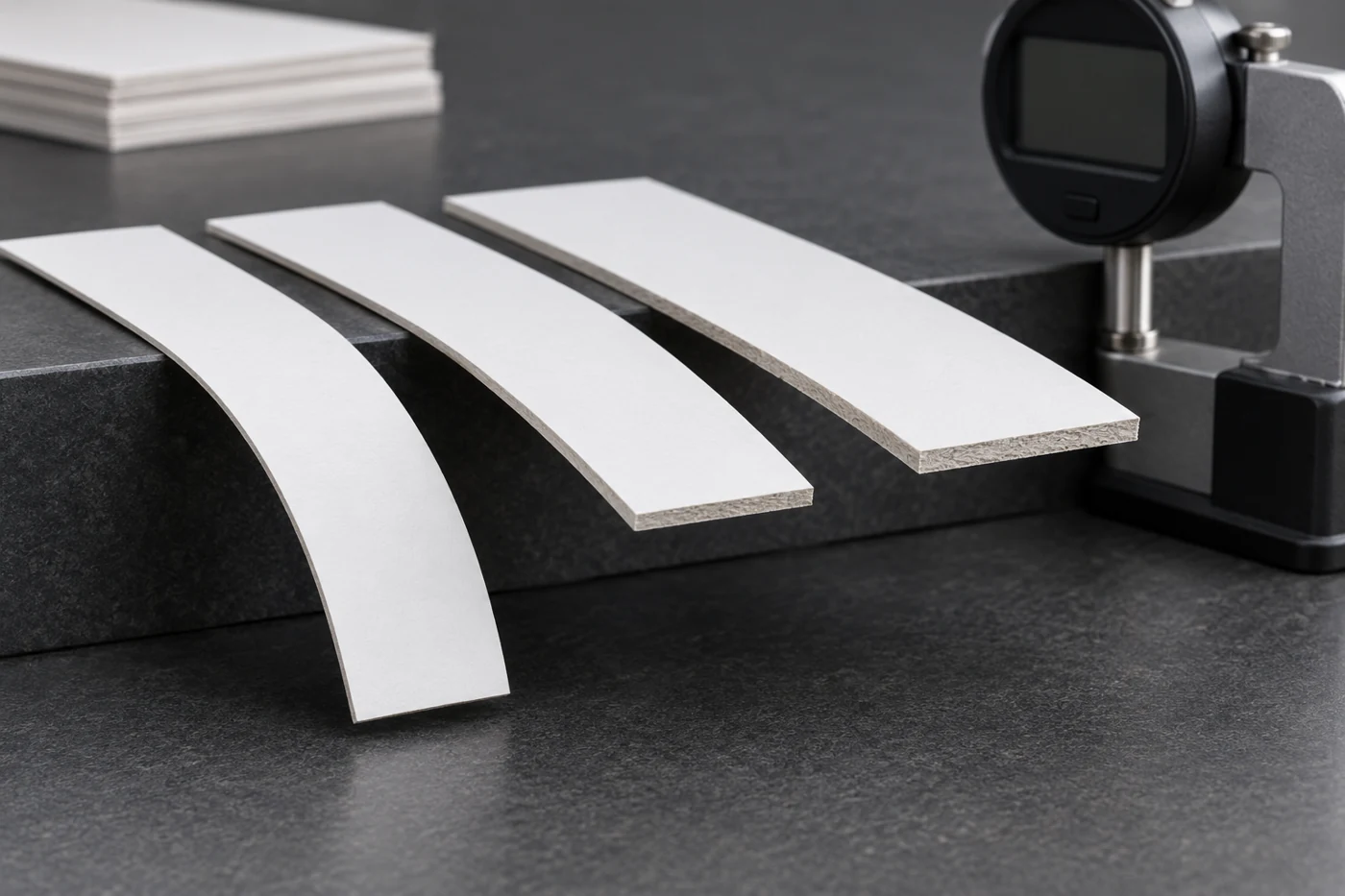
Machine direction and cross direction are not equivalent
Commercial board specifications commonly report stiffness in the machine direction (MD) and cross direction (CD). These values can differ substantially. A recent official MetsäBoard Classic FBB product sheet, for example, lists grammage, thickness, and separate MD/CD bending-stiffness values rather than presenting gsm as a complete performance description.
Grain orientation should therefore be reviewed on the imposed dieline. The best orientation depends on the critical panels, folds, and opening behavior. A custom flip-top cigarette carton needs both clean converting and a stable body around a frequently used lid. The engineer may need to balance hinge behavior against panel rigidity and sheet yield.
Panel span can overpower a reasonable board
A broad, uninterrupted panel deflects more easily than a narrow panel. Increasing the carton’s width or height while retaining the same board can change perceived quality even though the material specification is unchanged. Windows, perforations, tear strips, finger notches, and large glue-free areas can further reduce local support.
This is why the 300–350 gsm range shown for custom disposable vape boxes cannot be selected without considering the proposed structure. A compact tuck-end carton, a window carton, and a sleeve-and-drawer format distribute loads differently. The board decision should follow the finished dimensions, opening style, insert, and product mass.
Creases and closures create—or remove—structural support
Once a carton is erected, its edges, locked flaps, glue seams, and dust flaps help panels resist deformation. Weak locking engagement, generous clearances, poor score placement, or inconsistent glue can make a satisfactory sheet feel loose as a box. Conversely, a well-designed closure can make an efficient board feel precise and stable.
For cigarette boxes in flip-top, drawer, or magnetic styles, “same gsm” does not mean same construction. A folding carton derives much of its rigidity from folded geometry; a drawer sleeve gains support from the tray; a rigid magnetic box typically uses wrapped greyboard and should be specified by board thickness and construction rather than folding-carton gsm alone.
The product and insert are part of the structure
An insert can brace walls, hold a bottle away from the panels, and distribute load. If it is too small, too soft, or positioned poorly, the outer carton may bow or twist. If it is too tight, it can push panels outward. Test the complete pack with the real product or a dimensionally and mechanically representative surrogate.
This matters for custom CBD packaging for bottles, cartridges, gummies, and topicals, where the product shape and insert system vary widely. A bottle carton with a paper holder should not inherit its board choice from a lightweight cartridge carton simply because both are printed at the same size on screen.
Should you increase GSM, change board grade, or redesign the box?
| Observed problem | First variable to review | Useful controlled trial | Trade-off to assess |
|---|---|---|---|
| Panels bow while the flat sheet seems substantial | Panel span, grain direction, closure and insert | Add internal support or revise panel geometry using the same board | Assembly time, material use and packing access |
| Two suppliers quote the same gsm but samples feel different | Named grade, caliper, density and MD/CD stiffness | Compare technical data and conditioned production-intent samples | Availability, price and print surface |
| Carton is firm but too heavy or expensive | Board efficiency and structural reinforcement | Test a higher-bulk grade or stronger geometry at lower grammage | Runability, surface finish and sourcing consistency |
| Box loses shape after the product is inserted | Product clearance and insert load paths | Pack actual components and adjust insert fit before changing board | Protection, unboxing and packing speed |
| Premium presentation is required with broad flat panels | Construction family | Compare folding carton, sleeve-and-drawer and wrapped rigid-board samples | Freight volume, unit cost and assembly |
The least expensive correction is often structural, but not always. A small locking-tab adjustment may improve squareness at almost no material cost. A new insert can reduce panel movement. If the brand requires large, flat, presentation-grade surfaces, a change of construction may be more reliable than repeatedly increasing folding-board grammage.

How should buyers specify box rigidity?
For folding cartons
Start with the exact finished dimensions, product weight, board grade or approved equivalent, nominal grammage, nominal caliper, grain direction, and any available MD/CD stiffness data. Add the print and coating system because finishing can influence converting. Define closure engagement, acceptable panel bow, and packed-sample expectations.
A slim custom chocolate bar carton may perform well with a carefully selected folding board because its panel spans and load are controlled. The same gsm used for a larger gift assortment may not create the same result. The purchase order should identify the specific approved construction rather than applying one house gsm to every size.
For wrapped rigid boxes
Specify the greyboard thickness, wrapping paper, joint construction, lid style, internal tray, and permitted panel warp. Grammage can still describe the wrap, but it does not replace the core-board thickness. For a book-style magnetic rigid box, hinge geometry, magnet placement, wrapped edges, and insert fit affect perceived solidity alongside the greyboard.
For sleeve-and-drawer formats
Evaluate the sleeve and tray as a pair. The sleeve’s inside clearance, tray wall construction, pull direction, and insert position determine how much the components reinforce each other. A drawer-style 510 cartridge box should be checked for side-wall deflection, smooth travel, stop behavior, and packed fit—not only the gsm printed in the quotation.
What should a production-intent sample prove?

A digital mock-up can confirm artwork and approximate size, while a hand-cut white sample can confirm geometry. Neither automatically proves mass-production rigidity. Before approval, request samples that represent the proposed production board, grain orientation, creasing, finish, gluing, insert, and assembly method.
Use a repeatable review:
- Record the board manufacturer, grade, grammage, nominal caliper, and permitted substitution rule.
- Measure finished dimensions and inspect whether all panels sit square before packing.
- Pack the real product or an accurate surrogate with the intended insert.
- Inspect broad panels for bowing, oil-canning, corner collapse, closure gaps, and twist.
- Open and close working features for the agreed number of evaluation cycles.
- Compare the result with a signed reference sample under consistent lighting and handling.
- If the sample fails, change one controlled variable at a time and record the result.
For shipping protection, use a test plan appropriate to the product, distribution route, and risks; a “feels strong” desk review is not a transit-performance claim. Similarly, do not convert a supplier’s typical data-sheet values into a guarantee unless the purchase specification and test method explicitly make them acceptance criteria.
What belongs in the RFQ?
- Finished internal and external dimensions, product mass, center of gravity, and pack orientation.
- Box style, revision-controlled dieline, window/perforation locations, and critical display panels.
- Named board grade or performance-based equivalent; grammage plus caliper and stiffness where relevant.
- Required grain orientation or a documented supplier recommendation.
- Printing, lamination, varnish, foil, embossing, and any heavy finish near folds.
- Insert material, dimensions, retention points, and whether it is structural.
- Production-intent sample quantity, packed evaluation method, and signed reference sample.
- Rules for material substitution, change notification, defect classification, and corrective action.
This information also improves quote comparison. Without it, one supplier may price a dense commodity board, another a higher-bulk premium grade, and a third a redesigned insert. All three quotes may say “350 gsm,” but they are not offering the same performance.
Frequently asked questions
Is higher GSM always stronger?
No. Within the same board family, higher grammage often increases several strength properties, but box performance also depends on thickness, stiffness direction, grade, dimensions, folds, closures, and support. A higher gsm cannot compensate for every structural weakness.
Can caliper replace a stiffness specification?
No. Thickness is highly relevant, but bending stiffness is a measured response that also depends on the material construction and test direction. Use caliper and stiffness together when rigidity is critical.
Why did the approved sample feel better than production?
The sample may have used a different board, grain orientation, moisture history, cutting method, glue application, insert, or hand-assembly process. Require a traceable production-intent sample and control substitutions by grade—not only by gsm.
When should we move from a folding carton to a rigid box?
Consider a rigid construction when broad presentation panels, repeated opening, premium tactile weight, or a heavy product exceed what an efficient folding-carton design can provide. Compare the full trade-off: unit cost, setup, freight cube, storage, assembly, and end-of-life—not appearance alone.
Specify the performance, not just the paper weight
GSM is an important control, but it is one line in a complete packaging specification. Pair it with board identity, caliper, stiffness direction, structure, insert, packed-product evaluation, and change control. That gives suppliers a shared target and prevents an technically “correct” sheet from becoming a disappointing box.
For a material and structure review, send PaperBoxPro your dieline, finished size, product dimensions and mass, current board specification, target finish, and photos of any panel bowing or collapse. Request a custom packaging review and ask for a production-intent sample plan before approving mass production.