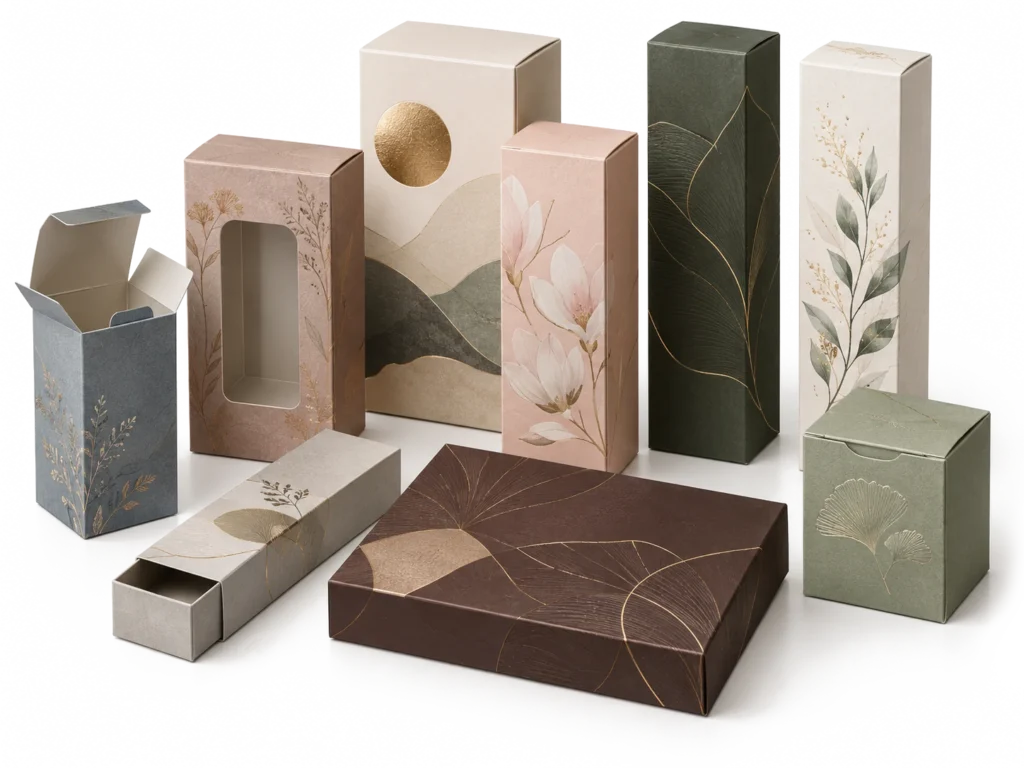
Choose printed white paper when the design depends on full-color images, pale areas or several artwork variants. Consider colored specialty paper when the paper’s own shade and surface are central to the design and the decoration can be selective. Compare the finished construction, available print route and total order cost before deciding: two dark green boxes can look similar in a photograph while requiring quite different materials and production steps.
The useful purchasing question is which route can deliver your intended appearance reliably at the required quantity. “Luxury paper” is not a complete specification. A buyer needs to distinguish the visible paper from the structural board, identify which areas are printed and decide what evidence will approve the result. This guide provides a selection brief rather than a universal ranking of the two options.
Separate the visible paper from the box structure
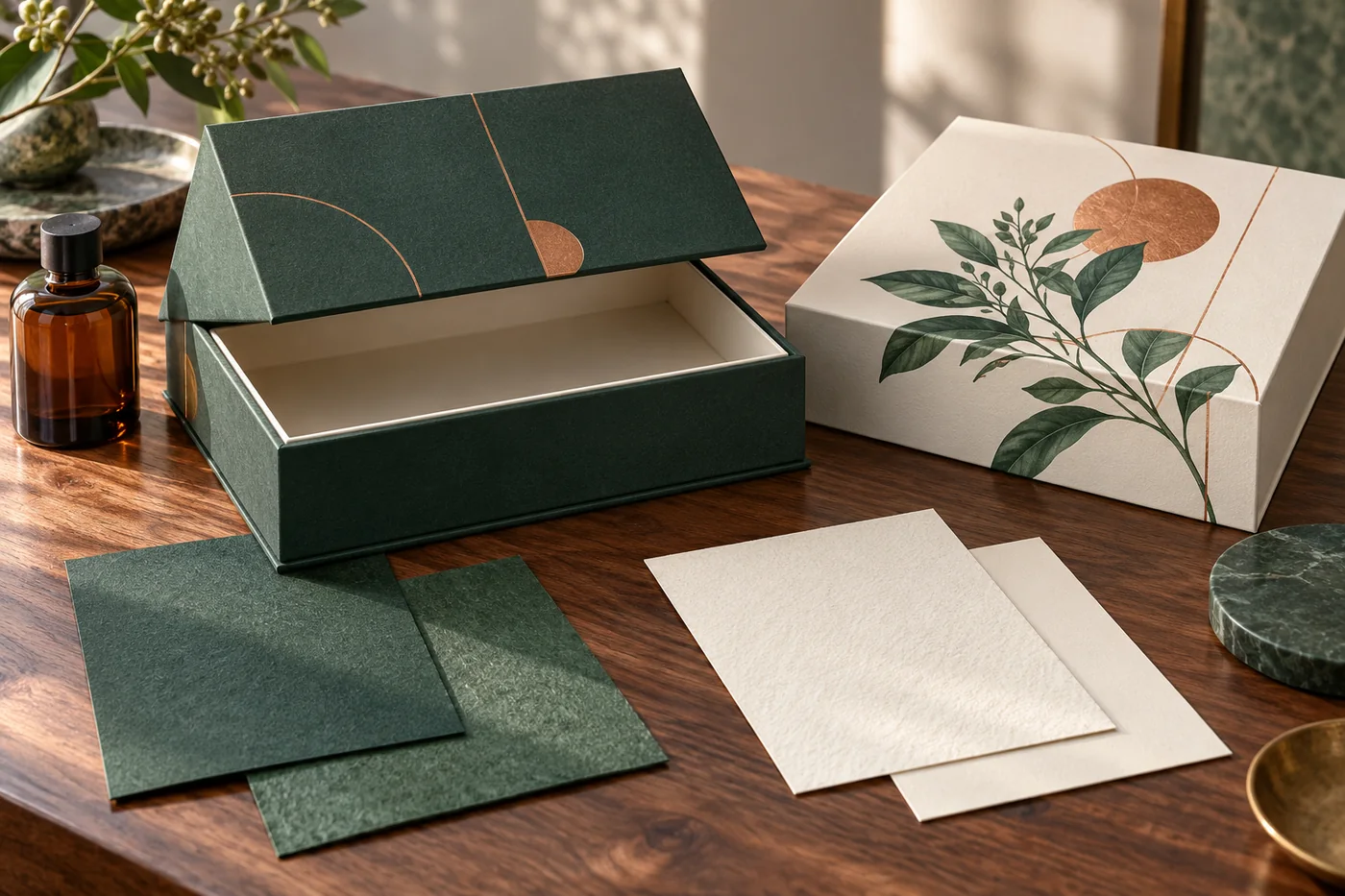
A folding carton uses its board for both the visible surface and much of the structure. In a wrapped rigid box, the decorative outer paper and the supporting board are separate components. Ask which component a proposed change replaces. Changing the wrap on a rigid gift box is a different engineering decision from replacing the board that forms a folding carton.
For paper-wrapped book-style gift boxes, request a construction description identifying the supporting board, outer wrap, inner lining and insert. If a quotation says “green paper,” clarify whether that means green artwork on a white sheet or a colored sheet used as the wrap. Do not compare wrap-paper weight with structural-board weight as though they serve the same job.
Keep the structure and intended product fit fixed during the first appearance comparison where practical. If one option changes both the box construction and its decorative surface, ask for those changes to be itemized. Otherwise, a lower price or different opening feel may be attributed to the paper when another component caused it.
Decide what creates the background color
In the printed-white-paper route, artwork creates the colored background over a white starting surface. In the colored-paper route, the chosen paper supplies the background and the decoration adds selected elements. Confirm the actual grade: colored specialty paper is a broad description, not proof that every sheet has the same surface treatment or color throughout its thickness.
As a specific manufacturer example, Fedrigoni’s Sirio Color technical sheet describes uncoated, pulp-dyed papers and boards. That identifies one material family, not every colored paper, and does not establish that PaperBoxPro stocks or uses it. Ask the converter for the proposed mill, grade, shade, weight and relevant current technical information.
| Design priority | Printed white paper: starting point | Colored paper: starting point | Evidence to request |
|---|---|---|---|
| Photographs and several pale colors | Compare a full-color proof on the proposed stock | First establish whether the intended colors are achievable | Actual-stock print trial |
| Paper texture with sparse decoration | Assess whether printing and finishing preserve the desired surface | Evaluate the shade and tactile surface before decoration | Undecorated and decorated swatches |
| Different versions sharing one structure | Quote artwork changes on a common base stock | Quote stock availability and decoration for every shade | Quantity breakdown by version |
| Visible edges and opening surfaces | Inspect the folded and cut construction | Inspect it as well; the grade name is insufficient | Assembled sample, not a flat swatch alone |
Check pale artwork before committing to dark stock
White ink may be needed for an intended light appearance on a nonwhite substrate. PRINTING United Alliance explains that a white underbase can reduce the substrate’s influence, and that its opacity and print condition affect the colors above it. See its technical discussion of white ink in color management. A named brand color alone therefore does not define the complete production route on dark paper.
For purchasing, ask whether the supplier can produce the required light elements on the proposed grade, by which process and at what added cost. A white area in a design file may represent unprinted white stock in one route but require a separately specified operation in another. Do not assume a standard CMYK quote includes white ink, extra passes or the same appearance on both substrates.
If the light areas contain necessary product information, resolve their readability before approving the material. A small successful logo test does not approve a larger pale illustration or a dense text panel. Request representative artwork elements at finished size. If a suitable trial is unavailable, retain the white-paper route or redesign the decoration rather than approving an unverified assumption.
For white-card retail packaging with custom printed finishes, compare the approved information layout and graphics before discussing a dark-stock alternative. The product page lists white-card construction and several formats; it does not confirm that every format supports a particular specialty paper or white-ink process. Request confirmation for the exact ordered structure.
Use decoration to support the material choice
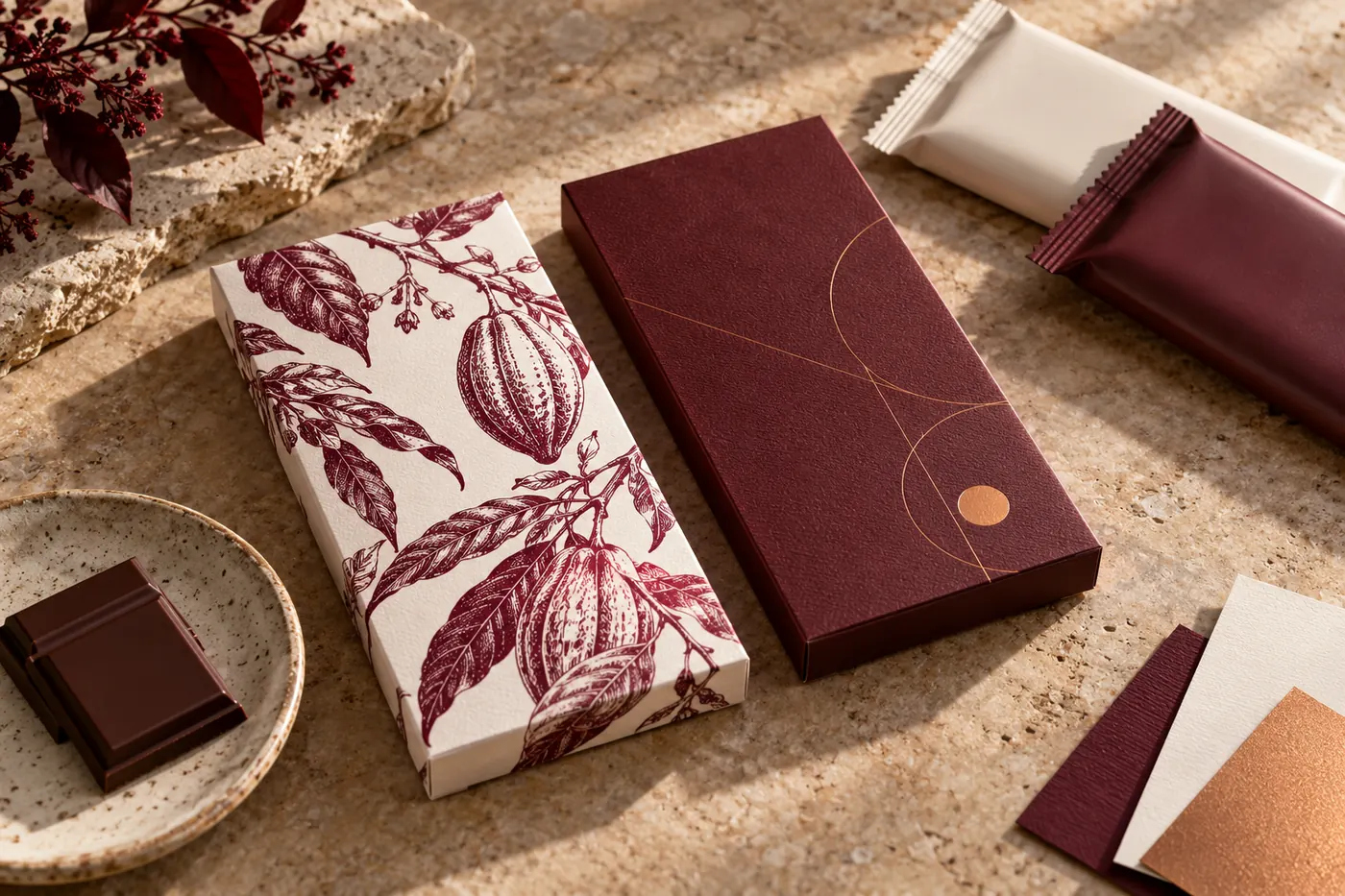
Prepare two intentional design routes. One might use a printed image, several background colors and unprinted pale areas on white paper. The other might use the paper’s own color with a limited foil motif or embossed detail. Comparing those routes can be commercially useful, but they are different design proposals. If an exact visual match is essential, say so before the supplier quotes them as alternatives.
For festive chocolate bar cartons with decorative finishing options, a seasonal illustrated design and a restrained colored-paper design may meet different presentation goals. Ask which parts of the artwork must remain identical and which can change. These are outer-packaging design choices; the paper’s appearance does not establish suitability for direct contact with the chocolate.
A paper’s attractive bare surface is not evidence that every coating or film will work on it. Fedrigoni’s cited sheet specifically calls for advance assessment of varnishing and plastic lamination for that grade. Treat a coating trial as a separate approval item. Do not apply one manufacturer’s guidance indiscriminately to another paper.
Ask for the complete decorated sample
Request the actual proposed paper with the intended ink, foil, relief or coating sequence. A swatch can help select a shade and feel; an assembled sample answers whether that selection works in the converted package. Record any substitutions used in a sample so it cannot accidentally become evidence for a material that was never tested.
Inspect edges, folds and inside surfaces
Open the package and examine the cut edges, corners, turn-ins and areas exposed during use. Decide which surfaces the customer sees and which color is intended there. For a wrapped box, ask how the inside lining and the covered board edges are specified. For a folding carton, review the inside face and closure flaps as part of the design.
For custom flip-top paperboard packs, the lid and opening sequence expose more than the front artwork panel. Include those surfaces in the sample review. A different paper choice still needs to suit the agreed folds, closure and information layout; a premium shade cannot compensate for a package that fails its functional checks.
Do not assume colored paper makes scuffs invisible, prevents cracking or eliminates edge contrast in every construction. Ask to see the actual cut and folded sample and agree on relevant handling checks. If a visible white edge is objectionable, first identify the component causing it before requesting an expensive change to all the paper in the package.
Compare supply and cost by component
Request quotations at the same quantity per design, dimensions, structural specification and delivery basis. Separate base paper, printing, decoration, tooling, assembly and sample charges where possible. A colored sheet with less printed coverage is not automatically the less expensive finished package; a white sheet with more artwork is not automatically the cheaper option either.
Ask about stock availability by shade and weight, minimum purchase quantities for the proposed material, and what happens to unused specially purchased stock. Distinguish the minimum paper purchase from the minimum finished-box order. Clarify who owns any remainder, whether storage is available and whether that stock can be reserved for a later order. Treat these as terms to confirm, not standard supplier promises.
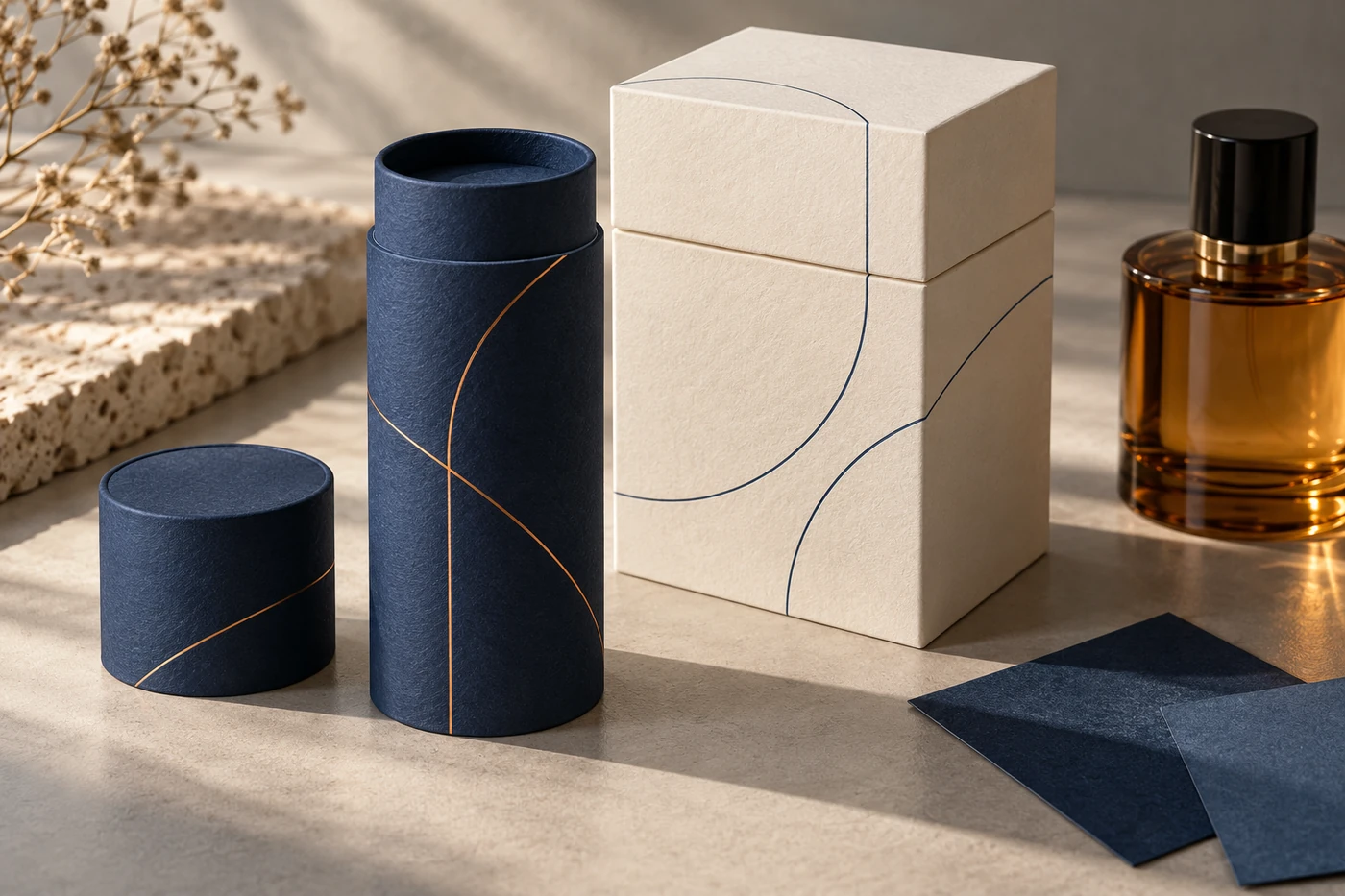
For a coordinated range of luxury paper boxes and removable-cap tubes, obtain material and decoration proposals for each format. That page offers paper textures and specialty-paper finishes, but the final grade and compatibility still require confirmation. If matching the formats is important, approve them together rather than assuming that a shared color name guarantees the same appearance.
Use a route comparison that exposes extra operations
For example, a buyer could request Route A as printed white wrap with a specified protective finish and Route B as a colored wrap with a foil motif. The comparison should show each route’s finished appearance, material commitment, setup charges, unit cost and approval steps. If Route B also needs a white information panel or a separate label, include that operation in the price and sample scope.
This is a quotation framework, not a claimed price saving. Select between verified finished proposals. If the routes deliver different visual outcomes, record which outcome the buyer accepts before comparing their costs.
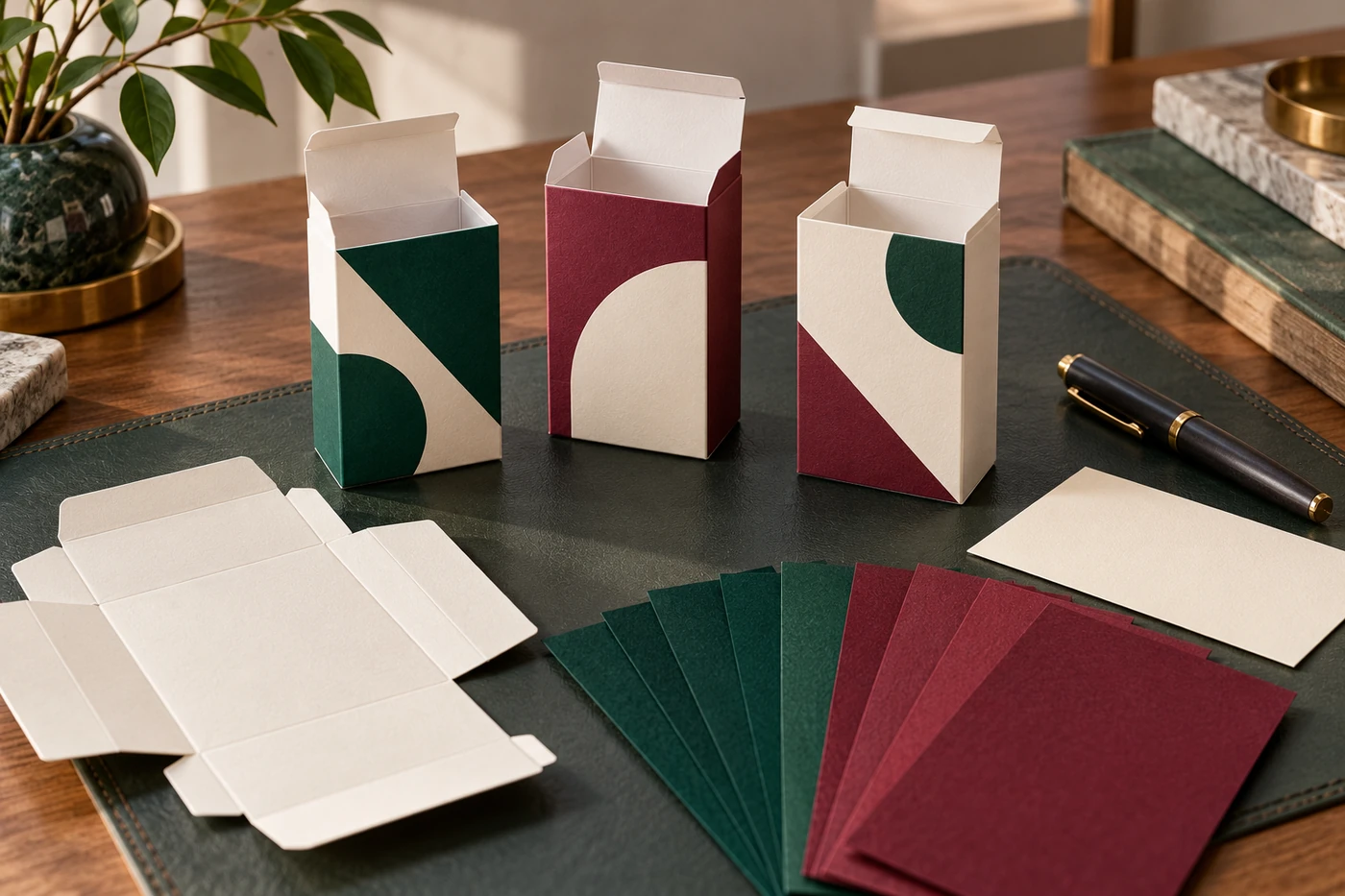
A material-selection brief to send before sampling
- Identify the box structure and whether the paper is a wrap, lining or structural carton board.
- Describe the intended background: printed color, stock color or a combination.
- Provide finished-size artwork, highlighting pale areas and necessary information.
- List the intended print and finishing operations, including any white ink or label proposal.
- Request the material’s manufacturer, grade, shade, weight and proposed alternatives.
- Specify visible edges, inside faces and opening surfaces that need approval.
- Ask for actual-stock decorated and assembled samples with substitutions identified.
- Compare cost, availability and unused-stock commitments by version and format.
Freeze the chosen material reference and decoration route with the approved sample. If the supplier later proposes a substitution, review the changed component before production. Similar-looking paper swatches do not establish that the full package will behave or appear identically.
Frequently asked questions
Is colored specialty paper always more luxurious?
No. It is a material choice that can support a particular design. Compare the finished result, opening experience and quality of execution against the brand’s actual presentation goal.
Can I keep the same artwork on both routes?
You can use it as a starting reference, but ask the printer to identify changes needed for the proposed stock and process. Approve the resulting physical sample before assuming equivalence.
Does pulp-dyed paper remove the need for all background printing?
It can provide the chosen stock shade as the background. Additional colors, imagery and required information still need their own production plan. Confirm the actual material construction rather than relying on the phrase “colored paper.”
What if the preferred shade is unavailable?
Request separately quoted alternatives: another approved stock, a revised decoration route or printed white paper. Review samples and timing before authorizing a substitution.
Request two buildable proposals
Send PaperBoxPro your custom packaging brief with artwork, box style, product measurements, quantities and preferred paper effect. Ask which material and decoration routes can be quoted and sampled. A useful proposal explains how the intended appearance will be achieved, what remains to be tested and which commitments accompany the material choice.
Editorial context: AI-assisted drafting and model self-review using the linked technical sources and product pages. Images are AI-generated material-selection concepts, not controlled color proofs, actual customer orders or evidence of a particular supplied paper grade. No human review or material certification is claimed.